
Orient
Available on Manga Store
New
May 13, 2023 3:41 PM
#1
| Unfortunately, it seems like this series is getting axed, but I wrote up some thoughts on Inuda Yataro so I might as well post them. Just disregard any references to the future of the series since we might not be getting any of that. Legacy seems to be one of the reoccurring themes of Orient and I think Yataro’s character is a commentary on how negative aspects can be passed down. Yataro having been born disabled, narrowly avoided being killed by his family only being spared because he comes from a samurai background. Samurai often married off their children to establish alliances with other clans (Omiai) so that’s probably the reason they kept him around. His backstory seems to reference an aspect of feudal Japan, Mabiki (間引き) which means something to the effect of “to pull plants from an overcrowded garden” Here’s a video explaining the practice of Mabiki. https://www.youtube.com/watch?v=rURMmLyqtOk >Mabiki: The Japanese Practice of Killing Your Own Baby Since before he obtained the black crystal he wasn’t able-bodied, his parents probably didn’t have a high opinion of him. He seems to have internalized that which resulted in his Survival of the fittest philosophy, the Japanese version of that being Jakuniku-kyoushoku (弱肉強食) Meaning: The weak are meat; the strong eat. Chapter 66 has Yataro’s children do this literally, like a visual metaphor with his stronger children literally eating the weaker ones in order to get more powerful. The following Chapter 67 even features a visual showing a midwife in the act of Mabiki using the strangling method as one of Yataro’s examples of his ideology. The following quotes are from Yataro in that same chapter: “Lives are carefully selected, and only the superior children receive their parent’s love and resources” “There are only those who can contribute to the herd, and those who are no use whatsoever.” It’s ironic because this type of thinking is probably what caused his family to treat him the way they did. He seems aware that according to his own ideology he would be categorized as “weak”/“worthless” even after the black crystal made him able-bodied. That’s the reason why he stutters his words in front of the other Obsidian 8 (Chapters 43, 65, 77, 78, 79) as Seiroku pointed out, yet seems perfectly eloquent when talking to other people barring that one time in Chapter 55 when he’s referring to his Demon Metal Sword which isn’t all that impressive compared to his siblings. That’s why when his siblings told him to sit out the final battle at Awaji he feels slighted and why he’s so desperate to prove his worth and become the “strongest”. Chapters 93 and 113 basically confirms this is how he views himself, in the former after telling Michiru his backstory referring to himself as a “worthless human” “who has no value to anyone” and the latter when Michiru tells him how she feels about him, she mentions his personality flaws, but he lists physical flaws “Yes! I am ugly…weak.. a person with no value at all! That’s right isn’t it?!” like he’s repeating criticisms that he’s heard before. His ideology affects his interactions (or lack thereof) with his children, as seen in Chapters 62 and 72. Michiru’s backstory shows her amongst countless neglected bodies of Yataro’s daughters that he pretty much Mabiki’d. It was only after Michiru passed the sword test thus proving her worth that Yataro undid that decision and actually gave her a name. Something similar happens with Iwanami, one of the half-human half-demons that attacked Musashi, Akihiro and Michiru in chapter 65, the Volume 8 extra shows Yataro only wants daughters so Iwanami along with several boys were discarded. Yataro is inflicting the same trauma on Michiru and several of his children that his parents inflicted on him, perpetuating a cycle of intergenerational abuse. People have hypothesized that childhood abuse and neglect are passed down from generation to generation, but the actual data doesn’t seem so clear-cut. A paper titled “Do abused children become abusive parents?” published in 1987 by Joan Kaufman and Edward Zigler seems to conclude that “30% of abused and neglected children will later abuse their own children” I couldn’t get access to the paper itself but the links below reference it. >In a survey of such studies, Joan Kaufman and Edward Zigler, psychologists at Yale, concluded that 30 percent is the best estimate of the rate at which abuse of one generation is repeated in the next. https://www.nytimes.com/1989/01/24/science/sad-legacy-of-abuse-the-search-for-remedies.html 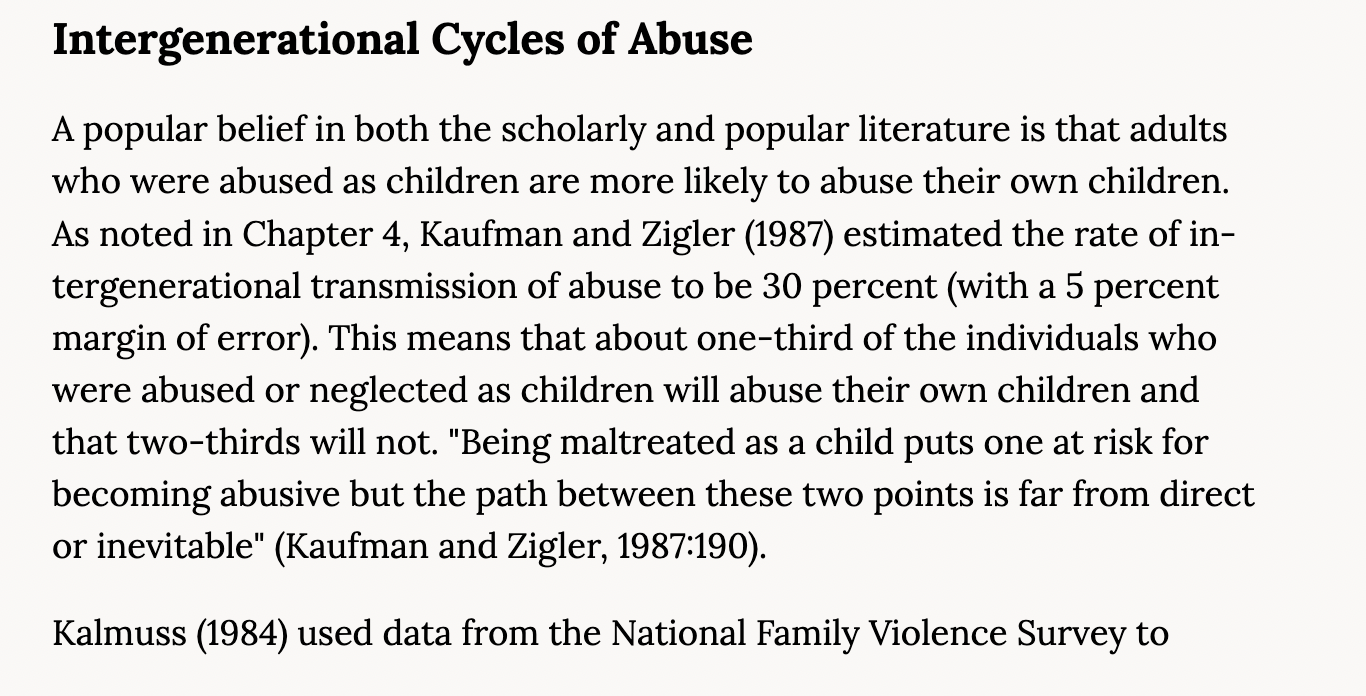 https://nap.nationalacademies.org/read/2117/chapter/8#223 The New York Times article also says this, which might be relevant to Yataro’s character. >The study found that the strongest predicter from childhood of becoming an abusive parent was not having been abused, but rather having felt as a child that one was unloved and unwanted by one's parents - an attitude common, of course, among abused children, but also found in families in which there is no overt abuse. The manga definitely seems to support these parallels between Yataro and Michiru, since in Chapter 93 when Yataro was explaining his backstory to Michiru talking about how he’s “…a worthless human… who has no value to anyone…” that triggers some of Michiru’s memories of being tossed aside along with those countless other bodies. Also in this Chapter 113 with the visual of child versions of Yataro and Michiru crying next to each other and before that the panel of baby Yataro being tossed after the midwife says he has a congenital defect is very similar to a panel of Michiru being tossed aside after being called a failure in Chapter 62, same “toss” sound effect as well.  Something similar happens with Akihiro and his father as well, in Chapter 54 Akihiro holds Musashi and Katsumi in this humiliating way and then a flashback in Chapter 101 we see this is something Akihiro’s father did to him and his brother.  Ohtaka has used the visual shorthand of two characters performing the same action to convey Legacy since Chapters 1 and 4 where Musashi is shown alongside Jisai when performing techniques he seemingly learned from him. While that form of Legacy is pretty explicit studying and learning sword techniques from master to student like in Koryu. In the case of Yataro and Akihiro, it seems to be implicit, something they have unconsciously assimilated from their parents. People are shaped by their environment so it isn’t too surprising that people pick up behavior patterns from their parents even if unknowingly. Actually, there’s a scene in Chapter 102 where Haruhisa seems to echo words said by his father and he’s seemingly shocked by that realization. Before that moment Tokisame mentions that Akihiro is as cold-hearted as their father. 9:08-10:22 in that Mabiki video talks about the story of Guo Ju, which is one of The Twenty-four Filial Exemplars. https://en.wikipedia.org/wiki/The_Twenty-four_Filial_Exemplars Filial Piety also seems to be an aspect of Yataro’s character (meaning he demands it of his children) as shown in his first physical appearance in the series, in Chapter 55 where his introduction is in this big panel of his daughters washing his body (and clothing him) with a basin nearby. Washing one's parent’s feet in a basin seems to be a common symbol of filial piety. Ohtaka depicting Yataro’s children washing his entire body was probably her trying to convey his overindulgence of this idea I guess. 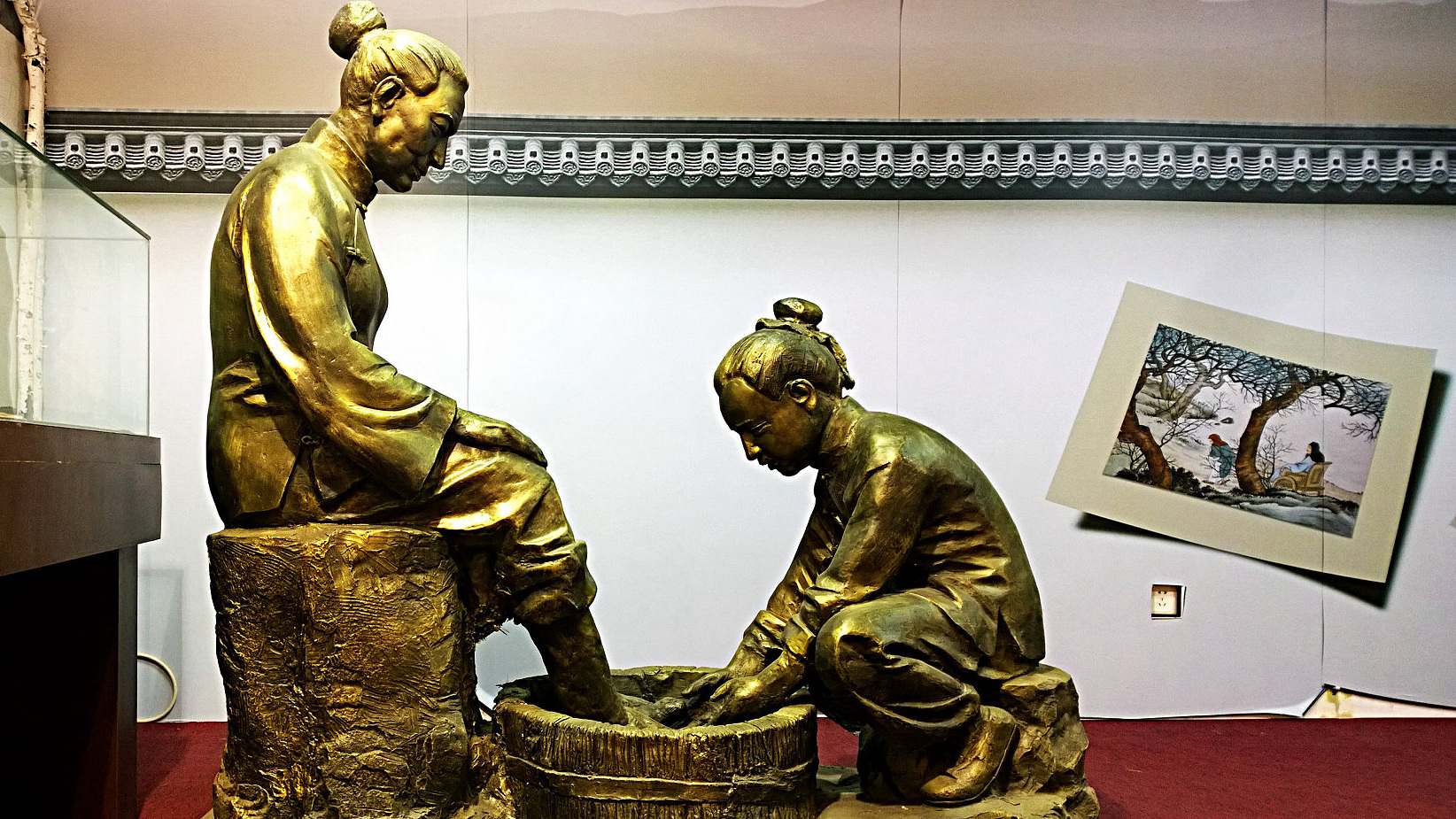 Picture from the article below https://news.cgtn.com/news/3d3d774d3459544e78457a6333566d54/share_p.html Quote from the article below >“People will see these perfect examples, and be inspired to do even better,” he said of his exhibits. “They may feel guilty that they don’t care enough for their parents, and return home to wash their parents’ feet. https://www.theguardian.com/world/2015/mar/30/filial-pursuit-china-museum-displays-family-values-campaign-0 https://www.asiaone.com/china/chinese-women-washing-feet-mothers-law-public-show-filial-piety-sparks-debate Chapter 78 also has a panel of his daughters feeding him and in Chapter 72 he outright says that: “I don’t need any children who can’t fulfill their duties! Children who aren’t useful to their parents are utterly worthless!” “Children mustn’t disobey their parents. They must always be faithful…” He doesn’t seem to have a blanket disregard for his children, he cares about his children in so far as they are useful and obedient to him. In Chapter 65 when asked by Seiroku how he found the Obsidian Goddess, he attributed the success to Michiru and praised her, but then when Michiru didn’t kill Musashi, he changed his tune and told her siblings to eat her in Chapter 67. And in a more twisted example when he turns Michiru into a Demon Metal Sword in Chapters 107 and 108 he again praises her calling her a “wonderful daughter” and saying “You’ve helped me bring my dreams to life. Your father is so happy!” In the novel Nansō Satomi Hakkenden which seems to have inspired the creation of the Obsidian Brotherhood, the story follows eight warriors each of which is assigned one of the eight fundamental virtues of Confucianism. https://en.wikipedia.org/wiki/The_Hakkenden Here’s a list of them, from the wiki entry of the OVA adaptation of the novel. * kō (孝) - filial piety * gi (義) - duty and obligation, but it can also be translated as righteousness * chū (忠) - loyalty * shin (信) - faith * tei (悌) - brotherhood; brotherly affection * jin (仁) - sympathy and benevolence, but note that, according to Confucianism, "jin" is also the greatest and most perfect virtue of all. It should come as no surprise that the bearer of this bead also happens to be the most powerful warrior of the eight. * chi (知) - wisdom * rei (礼) - courtesy, but this can also be translated as proper form, i.e. an extensive knowledge and proper observation of tradition and manners So I don’t think the filial piety aspects of Yataro’s character are a coincidence, and if it’s not then maybe the other members of the Obsidian Brotherhood might embody the other virtues. Even though it’s called a virtue, filial piety is kind of draconian and seems really susceptible to abuse, I mean there are literally examples in those 24 Exemplars that would constitute as abuse “His Filial Piety Moves Heaven and Earth” “He Obeyed His Mother and Wore Thin Clothes” “He Lay on Ice in Search of Carp” yet in these stories the children turn the other cheek and are meant to be “Exemplars” as in “a person or thing serving as a typical example or appropriate model.” So understandably there are critics of filial piety. https://www.youtube.com/watch?v=ktMqbbQzEg8 >Why Filial Piety is Bullshit || 为什么孝顺文化是Bullshit https://nextshark.com/filial-piety-toxic-asian-parenting “Obedience, sacrifice and obligations” it really does come across as a concept made to make children subservient to their parents, to the point that aspect can even be read in how filial piety is written. The kanji for filial piety is written like so 孝, it’s a combination of two other characters, one at the top and another at the bottom. The top is 老, which translates to “old”. The bottom one is 子 which means “son”. The arrangement of these Kanji has different interpretations, two of which are that the old are supported by the younger generation or the young are burdened and oppressed by the old (clearly this is the one relevant to Yataro’s character). Passage from >Filial Piety: Practice and Discourse in Contemporary East Asia Edited by Charlotte Ikels 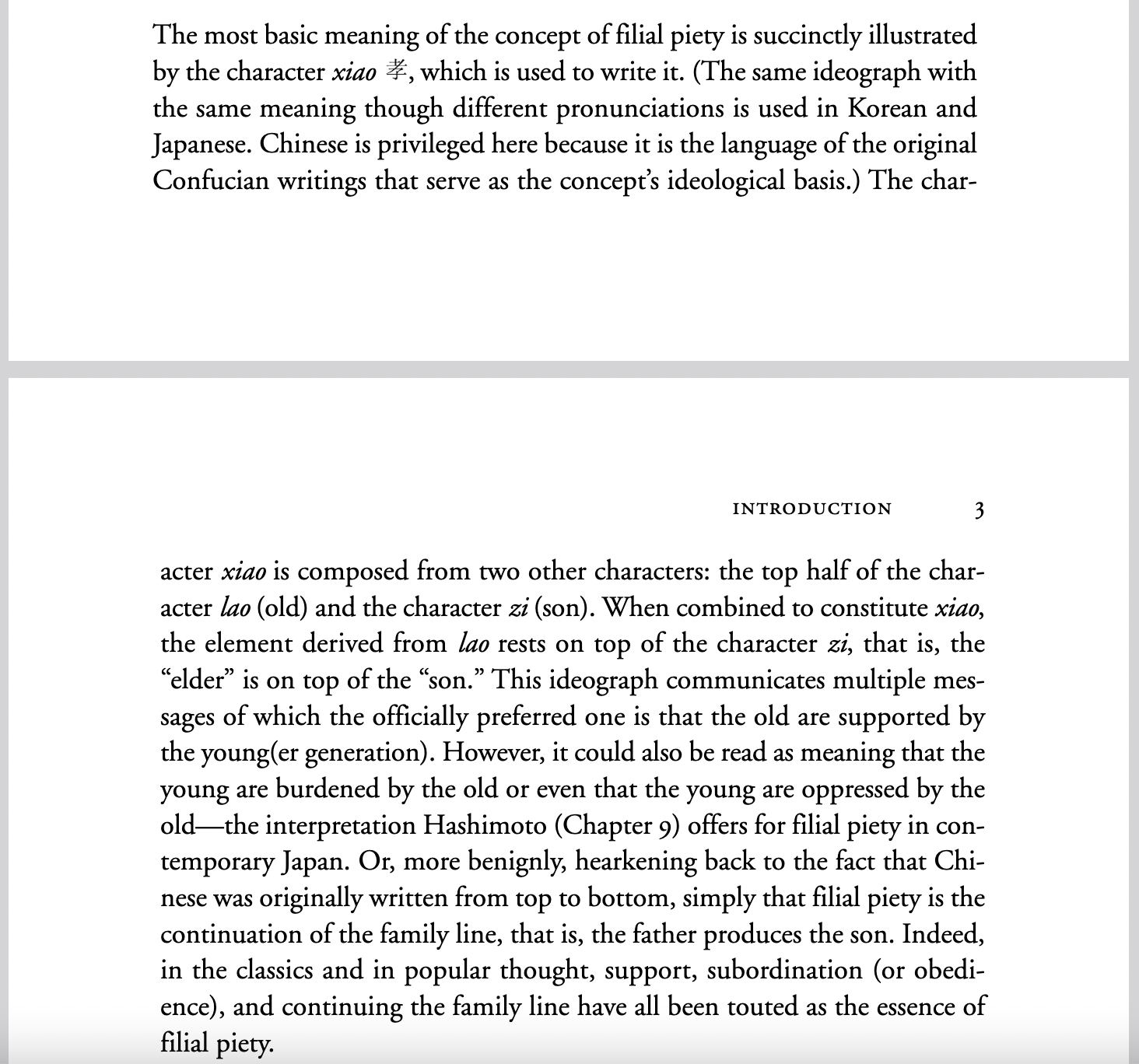 In regards to Yataro’s filial piety for his parents, the series doesn’t show much of his backstory, but he almost certainly got the “Children who aren’t useful to their parents are utterly worthless!” line from his parents. If the underlining idea behind filial piety is raising children so later on they could look after you (3:56) or continuing on the family legacy. Then with Yataro the other half of that exchange can’t really be fulfilled since Yataro wasn’t physically able to. I found a longer version of that Chinese saying she mentioned, that compares raising kids to rationing. 养儿防老, 积谷防饥 which means Raising children for old age, storing grain for hunger. Chapter 55 is when the series establishes that the ore that small Demons eat gets transferred to the Demon God it was birthed from, this probably helped reinforced the belief that the purpose of children is to benefit the parent in Yataro’s mind, similar to how in Chapter 67 he used the example of a mother cat eating one of her premature babies to reinforced his Survival of the fittest ideology. Chapter 58 Yataro comments on how Demons are strong because of their breeding ability, so that might be another way he’s mimicking them, in the Volume 8 extra Iwanami is apparently number 5073. If he really believes that is what makes them strong then it makes sense he’s copying them considering his hang-ups about being weak and worthless. So I guess it isn’t too surprising that he went ahead and made the full jump into becoming a Demon at the end of the arc. One of the top comments on that “Filial Piety is Bullshit” video says “Imagine filial piety in an abusive dysfunctional family” which seems to perfectly sum up Yataro’s whole deal. Chapter 61 Katsumi mentions that Demon Metal Swords somewhat reflects a person’s philosophy, so the visual metaphor of Yataro using his daughters as weapons (tools) in Chapters 95-97 and 107-112 as well as the whole “the weak are meat the strong eat” from earlier chapters is the final result of the combination of Filial Piety and that intergenerational abuse. Towards the end of the arc, Yataro kept stating him and Michiru are one in the same. Not really sure what he meant by that but maybe it has something to do with another one of Orient's themes, Conformity or maybe even Sociology as a whole. An example is the first chapter of the series where the popular sentiment was that Bushi were villains and Demons were benevolent deities, so Musashi is subjected to peer pressure to conform to that general state of affairs for fear of getting ostracized. Japan has a proverb for this phenomenon, Deru kui wa utareru (出る杭は打たれる) The nail that sticks out gets hammered down. That extreme collectivism kind of erodes away individuality, but the manga also shows positive aspects of Groupism. Chapter 59 states that Humanity’s greatest strength is their aptitude for cooperation, acknowledging good aspects of groupism since it’s one of their best weapons against the Demons, but taken to an extreme especially out of a military context it can be pretty suffocating. Confucianism seems to be one of the sources for this groupism that seems pretty intrinsic to Asian cultures. According to Confucian philosophy, individuals should strive to uphold the values of harmony, filial piety, and respect for authority (social hierarchy). People were encouraged to honor and respect their parents and observe a hierarchy of authority where a son obeyed his father's wishes, a younger brother respected and deferred to his older brother, and women did the same with men. In this way, the family would live harmoniously and, if enough families embraced filial piety, one would soon have a whole community of contented people, then a state, and then an entire country. That Nextshark article mentions how filial piety and being completely obedient to one's parents and placing their wishes above your own kinda undermines your own individuality. It also hotlinks to a page from a book where a scholar says Confucianism as a whole makes the individual no more than “a cog in an ever more efficient social machine”  This happens to Yataro’s other children who are all indoctrinated by his philosophy, completely making them instruments of his will (barring Iwanami) and extensions of him without any will of their own that goes against Yataro, only Iwanami differed when he couldn’t bring himself to eat Minami. Chapter 65 has Yataro's other children telling Michiru if she doesn’t do the task given to her by father she wouldn’t be apart of their family anymore, peer pressuring her into killing Musashi and when she doesn’t they try to kill her. This is juxtaposed with Musashi's extended family peer pressuring him into disavowing Jisai, because they didn’t want their family to be associated with anyone sympathetic to the reviled Bushi and open themselves up to scorn from other people, becoming the nail that gets hammered down. So Musashi’s Uncle takes his hoe and beats Musashi down instead. In feudal Japan and seemingly to some extent still in the modern day the Family/Household was another way groupism manifested, the good of the Ie was meant to take precedence over any individual's and the three principles to be followed by all were: obligation, obedience, and loyalty. Members of the household were expected to subordinate all their own interests to that of the Ie 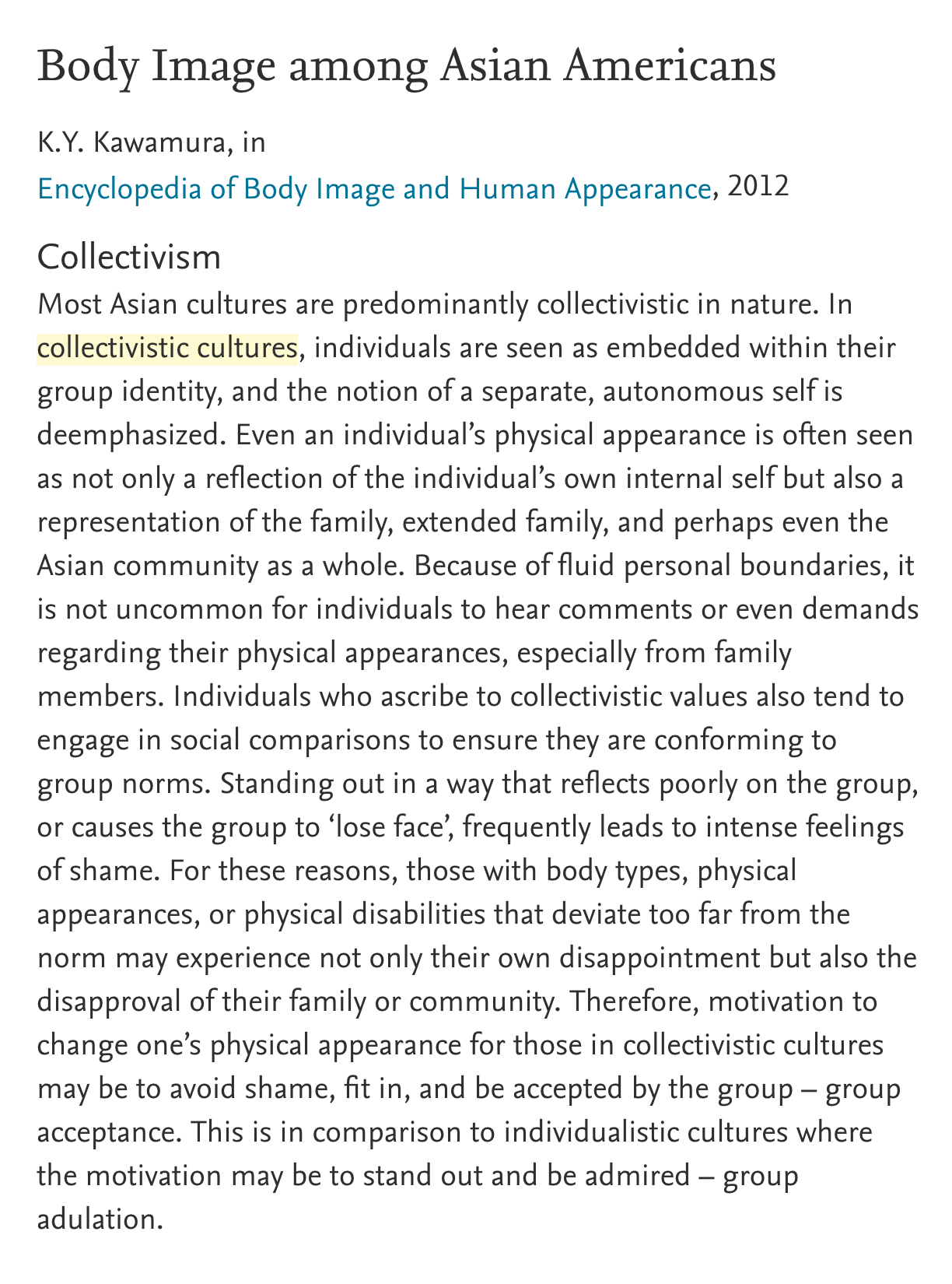 In the Sensescans translation Chapter 72, Yataro says “I don’t need my children to have individuality!” whereas the official translation uses “personality” instead. The “人格” in the raws seems like it can be translated into either of those along with “personhood” but I think individuality seems more like what Ohtaka was going for, judging by Yataro’s lines regarding Michiru recently. As stated in that Mabiki video, everything is done for the sake of the family/household, the individual be damned (9:13). So maybe that’s what Yataro meant when he kept saying he and Michiru are one in the same, a somewhat exaggerated reference to groupism. The manga directly draws parallels between Musashi and Michiru, as well as parallels between Michiru and Yataro, especially in this chapter. So there might be a through line to compare some parallels Yataro may have with Musashi.. >Both characters were neglected by members of their family Musashi was seen as a burden because he and his parents fraternized with the ostracized Bushi, so his presence reflected badly on his extended family. Yataro was born disabled and we can infer that his parents probably considered him worthless going by lines he said throughout the arc like in Chapter 67 “Lives are carefully selected, and only the superior children receive their parent’s love and resources” and “There are only those who can contribute to the herd, and those who are no use whatsoever.” >Both have an inferiority complex that stems from their backstories. Although now this is pretty obvious for Yataro, for Musashi it’s not as apparent but I think it’s there. Supposedly one of the ways inferiority complexes are developed is during childhood due to invalidating experiences or being raised in a family that influences you to feel lesser or not good enough. This is definitely the case in Musashi’s backstory in chapter 30 where he has that line about having nobody paying any attention to you is basically the same as being dead, and desperately wanting someone to acknowledge him as shown these in lines from the chapter “I want somebody to look at me…I want to be useful to somebody…” Some traits of Inferiority complexes that Musashi and Yataro seem to show -Very Sensitive To Criticism -Aggressiveness when feeling disrespected by others There are these two eerily similar moments where characters unintentionally slighted both of them. In Chapter 77 Seiroku is trying to console Yataro about being left out of the Battle of Awaji Island/Obsidian Goddess retrieval mission. Something similar happens in Chapter 3, Naotora tells Musashi that the Takeda will deal with the Kishin and he should just go and hide, putting his hand on Musashi’s shoulder while saying this. In Musashi’s case, it probably stung even more because before that he was bragging about how he put a hole in its stomach.  Chapter 6, Naotora talks down to Musashi and calls him weak after stealing his kill, with “weak” being emphasized with bold text (which is the same in the raws) resulting in Musashi losing his shit. Chapter 26, “Did you just come to make fun of me?” Musashi says to Shiro after failing his sword test. Chapter 48, Musashi gets all self-conscious when he thinks Naotora doesn’t remember him. Chapter 49, Tsugumi outright confirms that this is a trait that Musashi has, “Musashi is going to snap if you keep looking down on him…” Chapter 51, Musashi when about to meet his platoon says he has to “make sure… …they don’t look down on me” Chapter 52 “I’m kinda annoyed they left me out when they were talking about who’s the strongest here…” Chapter 47, Akihiro kicks Musashi and calls him weak which starts off their antagonistic relationship, in Chapters 52 and 54 Musashi still holds animosity for him even before Akihiro asserts his leadership. Naoe and Akihiro both disregard Musashi in Chapters 56 and 60, the former happens before the whole humanity’s greatest strength is their ability to cooperate moment so he reacts belligerently. While the latter happens after that so his reaction is more despondent to the point he almost deserts the military campaign. Chapter 79, Yataro complains “I’m always the only one out of the loop..” in Sensescans's translation, the equivalent line in the official translation doesn’t really meant much sense so it might be a mistranslation. Chapter 108, Natsuki saying Yataro is “Nothing to worry about” seems to provoke his first onslaught in his final Demon form, there’s even a “twitch” sound effect showing Yataro reacting to the remark and he sarcastically repeats the remark after decimating several Bushi. Amusing how even in this souped-up demon form he still has his insecurity, in Chapter 109 he mentions how he wants to kill all the people that looked down on him including Shiro and Seiroku. -They constantly seek validation from others. -They always talk about their achievements. Chapter 1, Musashi is talking about how he refuses to become a miner but as soon as his classmates start praising his mining ability he gets suckered in and gets a big head over it. Chapter 3, as mentioned before Musashi brags about “killing” the Kishin to the Takeda and when that isn’t the case he relentlessly tries to stop them from stealing his “kill” or “glory” depending on the translation. Chapters 5 and 6 have him complaining about his first achievement being stolen. Chapter 11, Hideo is able to butter him up, by praising his sword skills after in Chapter 10 he was worried that the Kosameda Bushi would look down on him like the Takeda did. Chapter 44, Yataro says “I-If I can clean up your mess for you… … would you praise me, Nanao-chan…?” Chapter 77, Yataro says to Shiro and Seiroku “M-M-My subordinates are quite useful, don’t you think?” Chapter 107, In regards to turning a human into a Demon Metal Sword he brags about being one step ahead of Shiro and in Chapter 108 he brags about creating a sword to rival the Obsidian Goddess. In Chapter 7 Musashi says “An enormous dream that nobody has accomplished in 150 years!!” “If the Demon Gods are too strong, and nobody else can do it…” “Then I’ll defeat them!!” “I’ll become stronger than you and all the other Bands of Bushi” Almost as if he’s saying if he achieves this goal that no one else has, that proves he has worth. Especially since before this, he seemed happy that they were so many Demon Gods out there (even though they’re kinda screwing over the country) because that gives him more chances to distinguish himself. This could parallel Yataro’s motivation to be stronger than anyone else as shown in Chapter 77 where Yataro says he’ll “stand on top of everything… I’ll be the most excellent” and Chapter 93 “I’m… …a worthless human… but that’s why… I must prove… …that I… am able to become the most superior being in existence…” In Chapters 23 and 30 the Obsidian Goddess seems to corroborate this reading of Musashi, with lines like “You’re not needed by anyone… …so you’ll do anything to make somebody need you!” the panel of Musashi after that just has ellipses and doesn’t show his eyes. Then in Chapter 32, Musashi seems to refute the Obsidian Goddess’ words but it seems to only be in response to her words about his reason for becoming a Bushi and not about the broader point of his supposed codependency. Since it’s pretty vague, we might have to wait and see if this aspect gets elaborated on later on in the manga. >Both are indebted to benefactors for saving them from situations in their backstory, Kanemaki Jisai for Musashi and the Demons for Yataro A passage from the “Sad Legacy Of Abuse: The Search For Remedies” TNYT article >the studies show. But many victims can overcome the trauma with the emotional support of a friend or relative or through therapy that makes them aware that they were not to blame for abuse inflicted by their parents. This is basically what happened with Musashi, in Chapter 32 Jisai saved him by removing him from that abusive environment, reaffirming his worth as a person and gave him a positive role model to look up too, although Musashi still appears to have some hang-ups, he’s definitely way better off than Yataro. Michiru did something similar in this Chapter (113) where she gives Yataro the unconditional affection that he wanted to hear from someone when he was young, I think that reminiscing leads him to finally start to recognize what he’s done to his daughter, but by the time he realized he inflicted the same trauma his parent did to him on to Michiru, it was far too late. I wonder what he was trying to say at the end. While the Demon’s black crystal gave Yataro an able body it didn’t really help heal his trauma and in the moments before his death, I think him wishing to hear those words of affection from someone when he was young was the series illustrating what he really needed. Making it kinda poetic that two of the children he neglected Michiru and Iwanami receiving that “emotional support” from someone else is what ended up being his undoing. |
More topics from this board
Poll: » Orient Chapter 156 DiscussionTrap_Traps_Traps - Oct 8, 2024 |
0 |
by Trap_Traps_Traps
»»
Oct 8, 2024 8:36 PM |
|
Poll: » Orient Chapter 154 DiscussionTrap_Traps_Traps - Aug 15, 2024 |
0 |
by Trap_Traps_Traps
»»
Aug 15, 2024 5:52 PM |
|
Poll: » Orient Chapter 152 DiscussionTrap_Traps_Traps - Aug 15, 2024 |
0 |
by Trap_Traps_Traps
»»
Aug 15, 2024 5:10 PM |
|
Poll: » Orient Chapter 133 DiscussionTrap_Traps_Traps - Jul 30, 2023 |
0 |
by Trap_Traps_Traps
»»
Jul 30, 2023 7:43 PM |
|
Poll: » Orient Chapter 123 DiscussionTrap_Traps_Traps - Jul 30, 2023 |
0 |
by Trap_Traps_Traps
»»
Jul 30, 2023 4:20 PM |