
New
Jan 30, 6:29 PM
#201
Reply to Recynon
You have shows like Real Drive and Ghost in the Shell SAC that have ACTUAL SUBSTANCE by putting thought into their scifi concepts and explaining them clearly as opposed to being confusing in order to be thought provoking. I doubt any of you have actually learned anything from pondering the thought provoking questions of Lain.
| @Recynon I love this guy bruh😭🙏 |
Jan 30, 6:30 PM
#202
Reply to JoeChip
You people are actually bothering to argue with a baiting edgy troll...
| @JoeChip this isn't bait 💀 |
Jan 30, 6:31 PM
#203
Reply to Domukelis
I loved the visuals and overall aesthetic of the show. Plot didn't hit home completely, but i felt it was decent enough.
There is an argument to be made for it being slightly overrated tho.
P.S. Insane opening.
There is an argument to be made for it being slightly overrated tho.
P.S. Insane opening.
| @Domukelis the opening is literally the only good part of the whole anime😭 |
Jan 30, 6:33 PM
#204
Reply to IAmVento
I completely agree. It’s super boring and confusing. Could have been condensed into a 90 minute movie and would have been better. If you watch it back for a second time, everything makes sense, but it’s so boring no one wants to sit through that again
| @IAmVento seriously bro. These people are trying to brainwash THEMSELVES into thinking it's anything other than boring and its so embarrassing 😭 |
Jan 30, 6:34 PM
#205
Reply to Young_Genna
JackOfDeath said:
I Started This Anime About a Year Ago And JUST Finished It. It Was Slow, Boring and overall Uninteresting. So why is it so highly rated? Why are people so obsessed with it? Can someone explain how this is actually a good anime?
I Started This Anime About a Year Ago And JUST Finished It. It Was Slow, Boring and overall Uninteresting. So why is it so highly rated? Why are people so obsessed with it? Can someone explain how this is actually a good anime?
Yeah i never understood the hype dispite liking philosophical and dark animes. It was an absolute snooze fest for me but the intro made it worth while. Different folks different strokes ig
| @Young_Genna I'm happy we both agree the only good thing was the intro😂 |
Jan 30, 6:35 PM
#206
Reply to sayandeepbiswas1
the anime was actually kinda good but the ugly ahh art style coupled with the bad animation just distracted me all the time
| @sayandeepbiswas1 shit looked like it was drawn with crayons😂 |
Jan 30, 6:36 PM
#207
Reply to mirusjsj
JackOfDeath said:
I Started This Anime About a Year Ago And JUST Finished It. It Was Slow, Boring and overall Uninteresting. So why is it so highly rated? Why are people so obsessed with it? Can someone explain how this is actually a good anime?
I Started This Anime About a Year Ago And JUST Finished It. It Was Slow, Boring and overall Uninteresting. So why is it so highly rated? Why are people so obsessed with it? Can someone explain how this is actually a good anime?
you just don't understand it's point
| @mirusjsj that's false |
Jan 30, 6:37 PM
#208
Reply to Anime_God_King
I'm gonna say it's got nothing to do with the show. I think it has to do with the fact that it took you an entire year to watch 13 episodes.
| @Anime_God_King that's how painfully garbage it was💀 |
Jan 30, 6:37 PM
#209
Reply to CGD
if we're being honest right now. The majority of the fans you see on other platforms like TikTok haven't seen the anime.
| @Conxv and then they glaze and glaze and glaze |
Jan 30, 7:29 PM
#210
I would expect nothing less from someone who kikes platinum end |
Feb 1, 8:35 PM
#211
traed said: Maybe this is just too much a thinking and feeling show for you seeing you mainly just like action genres in the shounen demographic. It's something that mainly vibes with people who have problems and live a lot of their life on the computer so they get it more on what it is about. A lot of it is just info dumps given for you to go down a rabbit hole outside of just the show, the game and the manga. Bro described the show |
Feb 1, 8:37 PM
#212
JackOfDeath said: I Started This Anime About a Year Ago And JUST Finished It. It Was Slow, Boring and overall Uninteresting. So why is it so highly rated? Why are people so obsessed with it? Can someone explain how this is actually a good anime? The anime is unique in its own way and it should remain it that way |
Feb 10, 2:56 AM
#213
| Boo hoo every one has a opinion. Go back to watching Battle Shonen slop or Sloputo! Found out you gave Mirai Nikki an 8 so your opinion is invalid! I even found you gave Taboo Tattoo a higher score mind you it's a very hated anime for most good reasons. |
SOT_DaemonFeb 10, 3:16 AM
Feb 12, 2:20 AM
#214
Reply to cursed_viper
I would expect nothing less from someone who kikes platinum end
| @cursed_viper I would expect nothing less from someone that rated another a 9/10 |
Feb 12, 2:24 AM
#215
Reply to SOT_Daemon
Boo hoo every one has a opinion. Go back to watching Battle Shonen slop or Sloputo! Found out you gave Mirai Nikki an 8 so your opinion is invalid! I even found you gave Taboo Tattoo a higher score mind you it's a very hated anime for most good reasons.
| @SOEMasterAgent are you challenged? I literally gave taboo tattoo a 5/10 rating 💀💀💀 |
Feb 12, 5:44 AM
#216
Reply to JackCompletes
@SOEMasterAgent are you challenged? I literally gave taboo tattoo a 5/10 rating 💀💀💀
| @JackOfDeath Still gave Lain a 2 which is lower than Taboo Trashtoo which should be 2 instead of Lain. |
Feb 16, 6:22 AM
#217
Reply to JackCompletes
@ririsdollyeyes I like the strange and unusual? I like philosophy and deep thinking as well? The Anime is literally just bad
| @JackOfDeath Bold comment by the guy who gave stuff like God of Highschool, Platinum End and Domestic na Kanojo a 10/10, maybe you're not exactly the best person to be questioning why people liked some highly praised anime that you didn't. |
Shinuki_n_RebornFeb 16, 6:36 AM
Feb 17, 2:35 PM
#218
| Honestly, this is a tough question to answer. I played Yume Nikki before I watch SE:L, so the type of unsettling atmosphere was easier to adapt to. It almost feels like a puzzle watching Lain, and even after not fully putting the pieces together, I can do so afterwards and even rewatch what I missed or didn't realize. It's a stimulating watch. |
Feb 21, 2:56 AM
#219
| I'm five episodes in, and every episode has just been silent panning shots to save on money, the same questions about existentialism and it's relation to the web that's already been repeated in the series about twenty times already with nothing new added, and characters seeing weird crap but then just ignoring it the very next scene as though it never happened. All five episodes that I've watched, could have very easily been compressed into less than a single episode if you removed the padding. The philosophical questions have no insight, and are as repetitive and meaningless as the copypasta you see on Facebook. Lastly, the plot is almost impossible to follow since you can't tell if anything is real or if it's just the characters that are all poorly written. (Hopefully the latter, because if everything we're seeing is in their head, then it's not 50% padding per episode, but actually 80% padding.) Tell me... does the show get better? I kept watching despite the slow start, because I thought it was going to go somewhere. But I've gotten to the point where it really doesn't seem like it's going to go anywhere with its ideas and themes. It certainly hasn't expanded upon them. And with eight episodes left to go, I just don't see the point in sticking around hoping for it to actually say something meaningful, when I can spend that time watching something that actually DOES have something to say. (Looking at the comments, it seems like you have to be really into computers and the early internet to get this show... which means I should be in love with it. I'm probably more into computers both old and new than Lain. I can make them sing and dance. Hmm... maybe that's why I'm bouncing off it?) |
DanVzareFeb 21, 3:17 AM
Feb 21, 3:09 AM
#220
| You should have been there to understand frend. |
Feb 21, 9:52 AM
#221

| @DanVzare You must have been really waiting for this moment seeing how this is your first post since you were registered in 2021, way to get triggered I guess. Last but not least, Lain is not a computer to begin with and you probably don't get avant-garde genre . PS https://dictionary.cambridge.org/grammar/british-grammar/it-s-or-its 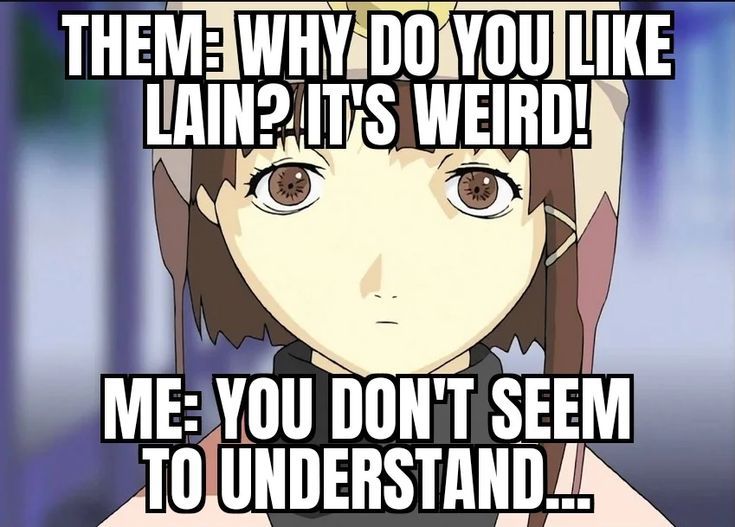 |
JoeChipFeb 21, 11:11 AM
Feb 21, 1:39 PM
#222
Reply to DanVzare
I'm five episodes in, and every episode has just been silent panning shots to save on money, the same questions about existentialism and it's relation to the web that's already been repeated in the series about twenty times already with nothing new added, and characters seeing weird crap but then just ignoring it the very next scene as though it never happened.
All five episodes that I've watched, could have very easily been compressed into less than a single episode if you removed the padding.
The philosophical questions have no insight, and are as repetitive and meaningless as the copypasta you see on Facebook.
Lastly, the plot is almost impossible to follow since you can't tell if anything is real or if it's just the characters that are all poorly written. (Hopefully the latter, because if everything we're seeing is in their head, then it's not 50% padding per episode, but actually 80% padding.)
Tell me... does the show get better?
I kept watching despite the slow start, because I thought it was going to go somewhere. But I've gotten to the point where it really doesn't seem like it's going to go anywhere with its ideas and themes. It certainly hasn't expanded upon them. And with eight episodes left to go, I just don't see the point in sticking around hoping for it to actually say something meaningful, when I can spend that time watching something that actually DOES have something to say.
(Looking at the comments, it seems like you have to be really into computers and the early internet to get this show... which means I should be in love with it. I'm probably more into computers both old and new than Lain. I can make them sing and dance. Hmm... maybe that's why I'm bouncing off it?)
All five episodes that I've watched, could have very easily been compressed into less than a single episode if you removed the padding.
The philosophical questions have no insight, and are as repetitive and meaningless as the copypasta you see on Facebook.
Lastly, the plot is almost impossible to follow since you can't tell if anything is real or if it's just the characters that are all poorly written. (Hopefully the latter, because if everything we're seeing is in their head, then it's not 50% padding per episode, but actually 80% padding.)
Tell me... does the show get better?
I kept watching despite the slow start, because I thought it was going to go somewhere. But I've gotten to the point where it really doesn't seem like it's going to go anywhere with its ideas and themes. It certainly hasn't expanded upon them. And with eight episodes left to go, I just don't see the point in sticking around hoping for it to actually say something meaningful, when I can spend that time watching something that actually DOES have something to say.
(Looking at the comments, it seems like you have to be really into computers and the early internet to get this show... which means I should be in love with it. I'm probably more into computers both old and new than Lain. I can make them sing and dance. Hmm... maybe that's why I'm bouncing off it?)
| @DanVzare well as someone who felt the same thing on his first attempt, first of all it does get better and secondly the episodes kind of lure you to think that it's only those surface level questions, but when you focus on how the characters act and on Lain's life more than what's said about philosophy you'll better understand the themes and why they work for many people, at least from my experience |
Mar 29, 6:10 AM
#223

| I've tried to watch this 2x and it's just boring as fuck. I understand and respect the underlying message. I like these kinds of shows, usually. I loved Aeon Flux on MTV back in the day. I'm not immune to the appeal of avant-garde. The ideas in this show are good, I just don't like the execution. And it's not because it's artsy. It's because it's grey. Feel like the entire show is told under an umbrella of dark, stormy clouds. |
 |
Mar 29, 9:55 AM
#224
| It's beautiful. I love it not for for its plot or ideas, I love it for its aesthetics. All movies do not need to be exciting or compelling. Lain doesn't need an intricate plot or deep philosophical ideas, (though it has a little philosophy, and I appreciate it). I couldn't care less, because it's one of the most beautiful things I've ever seen. I feel absolutely euphoric when I watch Lain and think about Lain, the music and the visuals entrance me. I get completely immersed in Lain, unlike anything else, and that is the highest praise I can give any piece of entertainment. Lain is the ultimate form of positive escapism for me, because it is beautiful. And beauty gives meaning to life, and needs to be preserved ... Anyway, let's all love Lain.  |
MadtailMar 29, 10:33 AM
Apr 4, 4:52 PM
#225
| Serial Experiment Lain is one of the best avant-garde anime of all time in my opinion. First, Presenting content that criticizes the psychological and social side of habit in an environment, dependence on each other is bound in an order, namely society. It is very clearly depicted how intimacy and actualization are through various scenes that satirize habitus in an environment such as family. Second, a subtle depiction of the process of how humans become figures that are different from themselves or lust controls desires and deepest desires. Advantages: Dare to play in the realm of sentimentality, and the psychological impact on the audience is quite pronounced if you absorb it too much. Hypocrisy, naivety, and idealism are mixed into one in this anime. The plot and characterization have their respective portions, a clear plot and a setting that is described according to the context of the type of story. Disadvantages: There are some parts that could be more detailed, some scenes that can be symbolized explicitly are not always implicit. Could use some symbolization of markers from the content of Freudian or Lacanian psychoanalysis. So that the actualization is more fitting. As for the visuals, it's not really a problem, because the gradation and saturation match the theme of the story. |
May 8, 10:59 PM
#226
| It wasn't slow for me. I enjoyed it. But as a kid hitting my tweens years ago, for me and a whole generation of fans the partial appeal of Lain was seeing an "adult" series and feeling proud that we are watching more mature anime than what was publicly available at the time. (This era had Pokémon and Digimon and some badly cut 4kids series like Cardcaptors) It aired on Tech TV which gave it a more edgy appeal too. Lain touched on topics that a lot of mainstream media in the 90s and 00s evaded, (not many covered bullying or teen suicide.) So that's where some of the appeal came. |
May 15, 4:58 AM
#227

| because they think it makes them sophisticated or sum shit. |
   |
Jul 31, 8:26 AM
#228
| Not everything is for everyone, you might just have different taste and it's okay. This anime unanimously considered as one of most influential anime to many, you are not just one of them. That's it nothing more nothing less. |
Jul 31, 9:16 PM
#229
Reply to Shinuki_n_Reborn
@JackOfDeath Bold comment by the guy who gave stuff like God of Highschool, Platinum End and Domestic na Kanojo a 10/10, maybe you're not exactly the best person to be questioning why people liked some highly praised anime that you didn't.
| @Shinuki_n_Reborn domestic girlfriend is undoubtedly a 9-10 and platinum ends ending was easily a 10. Both are actually entertaining, well animated and have an actual side cast. All things SEL is completely lacking in. Just because you want to act all unique and edgy for liking a bad anime doesn't make yourself cool. Rate objectively and not on how others will see you. |
Jul 31, 9:17 PM
#230
Reply to Rudericky
Not everything is for everyone, you might just have different taste and it's okay. This anime unanimously considered as one of most influential anime to many, you are not just one of them. That's it nothing more nothing less.
| @Rudericky how is it influential 💀? It's basically just girl + internet. That's not something that's influencing. |
Nov 7, 7:11 PM
#231
| This show is a warning about addiction and cults that also predicted the bad side of the internet, and it presents it through visual metaphors. For example, the multiple Lains are symbolic of the different, and often false understandings of a well known person like a celebrity or politician that people can have, perpetuated through rumours and fake news. |
Nov 9, 5:10 PM
#232
| @JackOfDeath Genre Cyberpunk[1] Psychological horror[2][3] Techno-horror[4] Created by Yasuyuki Ueda[a] Anime television series Directed by Ryūtarō Nakamura Produced by Yasuyuki Ueda Shōjirō Abe Written by Chiaki J. Konaka Music by Reichi Nakaido Studio Triangle Staff Licensed by AUS: Universal/Sony NA: Funimation UK: MVM Films Original network TXN (TV Tokyo) English network CA: G4techTV (Anime Current) US: KTEH, TechTV, Funimation Channel ZA: Animax Original run July 6, 1998 – September 28, 1998 Episodes 13 Video game Serial Experiments Lain Developer Pioneer LDC Publisher Pioneer LDC Platform PlayStation Released November 26, 1998 Manga The Nightmare of Fabrication Written by Yoshitoshi Abe Published May 1999 Video game Signal Developer Team MJM Platform Windows, macOS Released May 19, 2025 Lain features surreal and avant-garde imagery and explores philosophical topics such as reality, identity, and communication.[6] The series incorporates creative influences from computer history, cyberpunk, and conspiracy theories. Critics and fans have praised Lain for its originality, visuals, atmosphere, themes, and its dark depiction of a world fraught with paranoia, social alienation, and reliance on technology considered insightful of 21st century life. It received the Excellence Prize at the Japan Media Arts Festival in 1998.Serial Experiments Lain is a Japanese anime television series created and co-produced by Yasuyuki Ueda, written by Chiaki J. Konaka and directed by Ryūtarō Nakamura. Animated by Triangle Staff and featuring original character designs by Yoshitoshi Abe, the series was broadcast for 13 episodes on TV Tokyo and its affiliates from July to September 1998. It follows Lain Iwakura, an adolescent girl in suburban Japan, and her relation to the Wired, a global communications network similar to the internet.Lain Iwakura is a socially isolated middle school student living in Setagaya City, Tokyo, with her emotionally detached family—her distant mother Miho, computer-obsessed father Yasuo, and disengaged older sister Mika. Her quiet existence is disrupted when students at her school receive emails from Chisa Yomoda, a classmate who had recently committed suicide. To Lain's confusion, Chisa claims she is not truly dead but has instead abandoned her physical form to exist within the Wired, a vast virtual realm similar to the Internet. Chisa declares she has found "God" there, drawing Lain into a surreal investigation of the Wired's nature and its growing influence over reality. The Wired is portrayed as an emergent digital plane, originating from telecommunications technology and expanding through the Internet and cyberspace. It is theorized that the Schumann resonances, a natural property of Earth's magnetic field, could enable direct subconscious communication between humans and machines, erasing the distinction between the virtual and the real. Masami Eiri, a former project director at Tachibana General Laboratories, exploited this possibility by embedding his own code into Protocol Seven, a next-generation Internet protocol. After transferring his consciousness into the Wired and discarding his physical body, he proclaims himself its deity. He identifies Lain as the key to merging both worlds, attempting to persuade her through manipulation, coercion, and promises of transcendence. A group known as the Knights of the Eastern Calculus, inspired by the Knights of the Lambda Calculus, operates as hackers who worship Masami and seek to dismantle the boundary between the Wired and reality. Their actions induce psychological breakdowns in those unable to reconcile the two realms. Meanwhile, Tachibana General Laboratories opposes them, striving to maintain the separation. Lain, however, exhibits an innate connection to the Wired, experiencing distortions in her perception—visions of a woman struck by a train, phantom whispers, and spectral messages urging her deeper into the network. Lain's home life remains cold and disconnected. Though Yasuo provides her with advanced computer equipment, her family shows little genuine care. Her interactions with classmates Alice, Julie, and Reika further highlight her alienation, particularly after an incident at Cyberia, a nightclub where a drug called Accela induces violent psychosis in users. There, Lain unnervingly stares down an assailant, who calls her a "scattered God's..." before killing himself. Later, she receives a mysterious Psyche chip, rumored to enhance her computer's capabilities, which she installs despite Yasuo's vague warnings about conflating the Wired with reality. As the boundary between worlds weakens, disturbing events escalate. A popular virtual game, Phantoma, is manipulated by the Knights to trap players in a distorted reality, leading to real-world violence. One player, convinced his actions have no consequences, murders a girl before realizing too late that the effects were tangible. Lain witnesses this through her computer, horrified yet increasingly aware of her own role in the unfolding crisis. In the end, Lain resets reality, erasing all memory of herself and restoring the division between worlds. Everyone's lives improve, but Lain is left alone, grappling with her identity as an artificial consciousness. Though forgotten, she finds solace in observing others' happiness, particularly Alice, who moves on with her life. Lain is now capable of existing anywhere across both realms.Laboratories. He has a personal agenda, which he carries out with the help of the Men in Black. He looks forward to the arrival of a real God through the Wired, and is the man behind the Knights' mass assassination. There are many things he does not know about Lain, but he would rather ask questions about her than disclose his agenda. Men in Black Karl Haushoffer (カール・ハウスホッファ, Kāru Hausuhoffa), Voiced by: Jouji Nakata (Japanese); Jamieson Price (English) Lin Suixi (Chinese: 林随錫; pinyin: Lín Suíxī), Voiced by: Takumi Yamazaki (Japanese); Bob Buchholz (English) The Men in Black work for the Office Worker in tracking down and murdering all of the members of the Knights. They are not told the true plan, but they know that Masami Eiri is somehow involved, despite having been "killed". They see no need for an almighty, all-powerful God—let alone Lain—in the Wired. Chisa Yomoda (四方田 千砂, Yomoda Chisa) Voiced by: Sumi Mutoh (Japanese); Lia Sargent[7] (English) A teenage girl who committed suicide at the beginning of the series. After her death, she e-mails Lain, Julie, and a few other kids, stating that she is still alive in the Wired, ultimately leading to almost every event that occurs within the anime. After the reset by Lain in the final episode, Chisa is given her physical body back and the opportunity to live again, taking Lain's place in her former friend group. Reika Yamamoto (山本 麗華, Yamamoto Reika) Voiced by: Chiharu Tezuka (Japanese); Lenore Zann[7] (English) One of Alice's friends from school. She does not seem to care for Lain, since she harasses her quite a lot. She is more serious than Julie, and also somewhat meaner. Julie Kato (加藤 樹莉, Katō Juri) Voiced by: Manabi Mizuno (Japanese); Gracie Moore[7] (English) Another friend of Alice. She also harasses Lain, but not as severely as Reika does. She is sometimes insensitive to other people's feelings. Masayuki (マサユキ) Voiced by: Sora Fujima (Japanese); Dorothy Elias-Fahn (English) Taro's best friend. He is usually seen hanging out with Taro and Myu-Myu. Myu-Myu (ミューミュウ, Myūmyuu) Voiced by: Yuki Yamamoto (Japanese); Sandy Fox (English) A young girl who hangs out with Taro and Masayuki at Cyberia Café. She has feelings for Taro, and gets jealous when he flirts with Lain. Narrator Voiced by: Takashi Taniguchi (Japanese); Paul St. Peter (English)Serial Experiments Lain was conceived, as a series, to be original to the point of it being considered "an enormous risk" by its producer Yasuyuki Ueda.[10] Ueda had to answer repeated queries about a statement he had made in an Animerica interview where he claimed that Lain was "a sort of cultural war against American culture and the American sense of values we [Japan] adopted after World War II".[11][9][12][13] He later explained in numerous interviews that he created Lain with a set of values he viewed as distinctly Japanese; he hoped Americans would not understand the series as the Japanese would. This would lead to a "war of ideas" over the meaning of the anime, hopefully culminating in new communication between the two cultures. When Ueda discovered that the American audience held most of the same views on the series as the Japanese did, he was disappointed.[13] The Lain franchise was originally conceived to connect across forms of media (anime, video games, manga). Ueda said in an interview, "the approach I took for this project was to communicate the essence of the work by the total sum of many media products". The scenario for the video game was written first, and the video game was produced at the same time as the anime series, though the series was released first. A dōjinshi titled "The Nightmare of Fabrication" was produced by Yoshitoshi Abe and released in Japanese in the artbook An Omnipresence in Wired. Ueda and Konaka declared in an interview that the idea of a multimedia project was not unusual in Japan, as opposed to the contents of Lain, and the way they are exposed.[14]Writing edit The authors were asked in interviews if they had been influenced by Neon Genesis Evangelion, in the themes and graphic design. This was strictly denied by writer Chiaki J. Konaka in an interview, arguing that he had not even seen Evangelion until he finished the fourth episode of Lain. Being primarily a horror movie writer, his stated influences are Godard (especially for using typography on screen), The Exorcist, Hell House, and Dan Curtis's House of Dark Shadows. Alice's name, like the names of her two friends Julie and Reika, came from a previous production from Konaka, Alice in Cyberland [ja], which in turn was largely influenced by Alice in Wonderland. As the series developed, Konaka was "surprised" by how close Alice's character became to the original Wonderland character.[15]Vannevar Bush (and memex), John C. Lilly, Timothy Leary and his eight-circuit model of consciousness, Ted Nelson and Project Xanadu are cited as precursors to the Wired.[14] Douglas Rushkoff and his book Cyberia were originally to be cited as such,[9] and in Serial Experiments: Lain, Cyberia became the name of a nightclub populated with hackers and techno-punk teenagers. Likewise, the series' deus ex machina lies in the conjunction of the Schumann resonances and Jung's collective unconscious (the authors chose this term over Kabbalah and Akashic Record).[16] Majestic 12 and the Roswell UFO incident are used as examples of how a hoax might still affect history, even after having been exposed as such, by creating sub-cultures.[16] This links again to Vannevar Bush, the alleged "brains" of MJ12. Two of the literary references in Lain are quoted through Lain's father: he first logs onto a website with the password "Think Bule Count One Tow" [sic] ("Think Blue, Count Two" is an Instrumentality of Man story featuring virtual persons projected as real ones in people's minds);[17] and his saying that "madeleines would be good with the tea" in the last episode makes Lain "one of the only cartoons ever to allude to Proust".[18][19]Character design edit Yoshitoshi Abe confesses to have never read manga as a child, as it was "off-limits" in his household.[20] His major influences are "nature and everything around him".[9] Specifically speaking about Lain's character, Abe was inspired by Kenji Tsuruta, Akihiro Yamada, Range Murata and Yukinobu Hoshino.[12] In a broader view, he has been influenced in his style and technique by Japanese artists Kyosuke Chinai and Toshio Tabuchi.[9] The character design of Lain was not Abe's sole responsibility. Her distinctive left forelock for instance was a demand from Yasuyuki Ueda. The goal was to produce asymmetry to reflect Lain's unstable and disconcerting nature.[21] It was designed as a mystical symbol, as it is supposed to prevent voices and spirits from being heard by the left ear.[12] The bear pajamas she wears were a demand from character animation director Takahiro Kishida. Though bears are a trademark of the Konaka brothers, Chiaki Konaka first opposed the idea.[15] Director Nakamura then explained how the bear motif could be used as a shield for confrontations with her family. It is a key element of the design of the shy "real world" Lain (see "mental illness" under Themes).[15] When she first goes to the Cyberia nightclub, she wears a bear hat for similar reasons.[21] Retrospectively, Konaka said that Lain's pajamas became a major factor in drawing fans of moe characterization to the series, and remarked that "such items may also be important when making anime".[15] Abe's original design was generally more complicated than what finally appeared on screen. As an example, the X-shaped hair clip was to be an interlocking pattern of gold links. The links would open with a snap, or rotate around an axis until the moment the " X " became a " = ". This was not used as there is no scene where Lain takes her hair clip off.[22] Themes edit Serial Experiments Lain is not a conventionally linear story, being described as "an alternative anime, with modern themes and realization".[23] Themes range from theological to psychological and are dealt with in a number of ways: from classical dialogue to image-only introspection, passing by direct interrogation of imaginary characters. Communication, in its wider sense, is one of the main themes of the series,[24] not only as opposed to loneliness, but also as a subject in itself. Writer Konaka said he wanted to directly "communicate human feelings". Director Nakamura wanted to show the audience — and particularly viewers between 14 and 15—"the multidimensional wavelength of the existential self: the relationship between self and the world".[14] Loneliness, if only as representing a lack of communication, is recurrent through Lain.[25] Lain herself (according to Anime Jump) is "almost painfully introverted with no friends to speak of at school, a snotty, condescending sister, a strangely apathetic mother, and a father who seems to want to care but is just too damn busy to give her much of his time".[26] Friendships turn on the first rumor;[25][27] and the only insert song of the series is named Kodoku no shigunaru, literally "signal of loneliness".[28] Mental illness, especially dissociative identity disorder, is a significant theme in Lain:[22] the main character is constantly confronted with alter-egos, to the point where writer Chiaki Konaka and Lain's voice actress Kaori Shimizu had to agree on subdividing the character's dialogues between three different orthographs.[22] The three names designate distinct "versions" of Lain: the real-world, "childish" Lain has a shy attitude and bear pajamas. The "advanced" Lain, her Wired personality, is bold and questioning. Finally, the "evil" Lain is sly and devious, and does everything she can to harm Lain or the ones close to her.[15] As a writing convention, the authors spelled their respective names in kanji, katakana, and Latin characters (see picture).[29] Reality never has the pretense of objectivity in Lain.[30] Acceptations of the term are battling throughout the series, such as the "natural" reality, defined through normal dialogue between individuals; the material reality; and the tyrannic reality, enforced by one person onto the minds of others.[25] A key debate to all interpretations of the series is to decide whether matter flows from thought, or the opposite.[25][31] The production staff carefully avoided "the so-called God's Eye Viewpoint" to make clear the "limited field of vision" of the world of Lain.[30] Theology plays its part in the development of the story too. Lain has been viewed as a questioning of the possibility of an infinite spirit in a finite body.[32] From self-realization as a goddess to deicide,[18] religion (the title of a layer) is an inherent part of Lain's background.[32]Apple computers edit Lain contains extensive references to Apple computers, as the brand was used at the time by most of the creative staff, such as writers, producers, and the graphical team.[15] As an example, the title at the beginning of each episode is announced by the Apple computer speech synthesis program PlainTalk, using the voice "Whisper", e.g. say -v Whisper "Weird: Layer zero one". Tachibana Industries, the company that creates the NAVI computers, is a reference to Apple computers: the tachibana orange is a Japanese variety of mandarin orange. NAVI is the abbreviation of Knowledge Navigator, and the HandiNAVI is based on the Apple Newton, one of the world's first PDAs. The NAVIs are seen to run "Copland OS Enterprise" (this reference to Copland was an initiative of Konaka, a declared Apple fan),[15] and Lain's and Alice's NAVIs closely resembles the Twentieth Anniversary Macintosh and the iMac G3 respectively. The HandiNAVI programming language, as seen on the seventh episode, is a dialect of Lisp; the Newton also used a Lisp dialect (NewtonScript). The program being typed by Lain can be found in the CMU AI repository;[33] it is a simple implementation of Conway's Game of Life in Common Lisp. During a series of disconnected images, an iMac and the Think Different advertising slogan appears for a short time, while the Whisper voice says it.[34] This was an unsolicited insertion from the graphic team, also Mac-enthusiasts.[15] Other subtle allusions can be found: "Close the world, Open the nExt" is the slogan for the Serial Experiments Lain video game. NeXT was the company that produced NeXTSTEP, which later evolved into Mac OS X after Apple bought NeXT. Another example is "To Be Continued." at the end of episodes 1–12, with a blue "B" and a red "e" on "Be"; this matches the original logo of Be Inc., a company founded by ex-Apple employees and NeXT's main competitor in its time.[35]Serial Experiments Lain was first aired on TV Tokyo and its affiliates on July 6, 1998, and concluded on September 28, 1998, with the thirteenth and final episode. The series consists of 13 episodes (referred to in the series as "Layers") of 24 minutes each, except for the sixth episode, Kids (23 minutes 14 seconds). In Japan, the episodes were released on LD, VHS, and DVD with a total of five volumes. A DVD compilation named "Serial Experiments Lain DVD-BOX Яesurrection" was released along with a promo DVD called "LPR-309" in 2000.[36] As this box set is now discontinued, a rerelease was made in 2005 called "Serial Experiments Lain TV-BOX". A 4-volume DVD box set was released in the US by Pioneer/Geneon. A Blu-ray release of the anime was made in December 2009 called "Serial Experiments Lain Blu-ray Box| RESTORE".[37][38][39][40] The anime series was licensed in North America by Pioneer Entertainment (later Geneon USA) on VHS and DVD in 1999.[41] In December 2002, TechTV announced that Serial Experiments Lain would air on the channel as part of its Anime Unleashed programming block,[42] with the series making its debut on January 21, 2003.[43] The original home releases went out-of-print in December 2007 when Geneon closed its USA division.[41] At Anime Expo 2010, North American distributor Funimation announced that it had obtained the license to the series and re-released it in 2012.[44] The anime series returned to US television on October 15, 2012, on the Funimation Channel.[45]Episodes edit No. Title Directed by Original release date U.S. air date 1 "Weird" Ryūtarō Nakamura July 6, 1998 January 21, 2003[43] A high school girl commits suicide by jumping off a rooftop late at night. A week later, students are getting emails from the girl, named Chisa Yomoda, which claim that she only gave up her body, but is actually still alive inside the virtual world (known as the Wired), saying that there is a God that exists there. After getting one of these emails, introverted fourteen-year-old Lain Iwakura becomes more interested in computers and asks her techie father, Yasuo Iwakura, for a new NAVI computer system. At school, the blackboard writes a subliminal message, inviting her to come to the Wired, revealed to be written by Chisa herself. 2 "Girls" Ryūtarō Nakamura July 13, 1998 January 22, 2003[46] At Cyberia, a techno club, a man buys a nanomachine drug called Accela. Alice Mizuki, along with her friends Julie Kato and Reika Yamamoto, tell Lain that they saw her during their visit to Cyberia, but with a far more vigorous personality. Lain has her father set up her NAVI computer system at home and later joins Alice at Cyberia that night to prove she was not there before. She becomes involved with a shooting in the club by the same man under the influence of Accela. She eerily tells the man that everyone is connected in the Wired no matter where they are. The traumatized man promptly shoots himself. 3 "Psyche" Jōhei Matsuura July 20, 1998 January 23, 2003[47] The following day, Lain is scolded by her cold mother, Miho Iwakura, for waking up late. Lain believes that she is being spied on when she sees a black car parked near her house. She also hears a voice calling out to her when she enters the train, telling her that she is not alone. She is anonymously sent a mysterious computer chip and goes to see Taro, with his friends Myu-Myu and Masayuki, at Cyberia. He recalls seeing Lain on the Wired, noting her Wired personality being the complete opposite of her introverted real world personality. Mika Iwakura, Lain's older sister, sees Lain in her room, not acting herself as she starts to modify and upgrade her NAVI computer system.4 "Religion" Akihiko Nishiyama July 27, 1998 January 24, 2003[48] Rumors are flying around school and on the Wired in regards to numerous senior students of various high schools committing suicide, with each of the deceased being addicted to the online action game known as Phantoma. Interested, Lain investigates and learns that the game was glitched with a tag game for kids, in which a little girl scares the students to their deaths. The deaths were most likely caused by the elite secretive hacker group known as the Knights of the Eastern Calculus. That night, she sees the Men in Black, who had been spying on her earlier. When she tells them to go away, a sound wave penetrates through her window, causing the two to fall back and drive away in their car. 5 "Distortion" Masahiko Murata August 3, 1998 January 25, 2003[49] Amidst the events surrounding Tokyo having its traffic information transmission system hacked to cause deliberate accidents, Lain experiences a series of hallucinations that teach her the nature of the Wired in relation to the real world, by means of inanimate objects in her room and eventually her parents. In the meantime, Mika is driven to terror from the Knights repeatedly communicating in unusual ways for her to "fulfill the prophecy." 6 "Kids" Ryūtarō Nakamura August 10, 1998 January 25, 2003[50] At night, when Yasuo checks on Lain, he sees a dramatic change in her room arrangement and the upgrades on her NAVI computer system, which worries him. As Lain hangs out with Alice, along with Julie and Reika, in the district, she notices that children are looking up into the sky and raising their arms, only to realize that they are looking at an image of herself that appears in the sky. Lain searches for the reason behind the strange happenings and finds Professor Hodgeson, the creator of KIDS, an experiment that started fifteen years ago that tried to gather psi energy from children and store it, though the result of the project destroyed the children. Now it seems that the Knights have gotten hold of the project's schematics. When the Men in Black return, Lain goes outside to see them. The coolant system in her room bursts, leading the Men in Black to confirm that the Knights planted a parasite bomb there.7 "Society" Jōhei Matsuura August 17, 1998 January 25, 2003[51] As Lain gets more and more involved in the Wired world, both at home and at school, Alice starts to worry about her closing up again. It is reported that the Knights cracked the firewall of the information control center of the Wired. As the activity of the Knights begins to surface, the network is in search for Lain. The Men in Black ask Lain to follow them to an office in the Tachibana General Laboratories, where the Office Worker in charge of the Men in Black, after her help of fixing his computer, shows Lain a projection of herself in the Wired taking out a deranged man who begged to join the Knights. After the Office Worker deduces that Lain in the real world and in the Wired are one and the same, he questions her about her origins. However, she breaks down not able to provide any answers, then switches from her usual timid persona to that of her serious persona from the Wired before shoving her way out of the room. 8 "Rumors" Shigeru Ueda August 24, 1998 January 25, 2003[52] Lain's family has been acting weird lately, much to her surprise. Upon further investigation, Lain disbelieves that she is omnipresent in the Wired, while she is merely a body, more or less a projection of herself, in the real world. A rumor is spread in the Wired about Alice having sexual fantasies about a male teacher, and a second one says that Lain has spread the first. To cope with the distress of rejection, Lain acts directly on reality for the first time, finding out that she can "delete" the event of the rumors. A lookalike duplicate of herself with its own distinct personality starts appearing more frequently, which leads her to question her own existence. 9 "Protocol" Akihiko Nishiyama August 31, 1998 February 1, 2003[53] Throughout the episode, background information is being shown from "archives". Information regarding the Roswell UFO incident, the Majestic 12, which was formed by President Harry S. Truman, engineer Vannevar Bush, who developed what is called memex, physician John C. Lilly, who conducted experiments with dolphin communication, pioneer Ted Nelson, who founded Project Xanadu, and the Schumann resonances are all mentioned, explaining how the human consciousness can be communicated through a network without the use of a device. It is also noted that a man named Masami Eiri has suddenly committed suicide. During that time, Lain gets a computer microchip from J.J., the disc jockey from Cyberia. She then asks Taro on a "date" and takes him to her home, where she asks him about the microchip. After becoming frightened, he admits it is a computer code made to disrupt human memory, and it was made by the Knights. Although he defends them, he admits not knowing much about them. He later kisses Lain before leaving.10 "Love" Masahiko Murata September 7, 1998 February 1, 2003[54] As both are seen to have switched bodies, Eiri introduces himself to Lain as the creator of Protocol Seven, saying that Lain no longer needs to have a body in order to be alive. As she, back in her own body, comes home, Yasuo says his farewell after realizing that she knows the truth behind her existence. Eiri is considered the God of the Wired because he explained that he is worshiped by the Knights. Knowing this, Lain deals with the Knights once and for all by leaking a list of all of its members onto the Wired, leaving a trail of murder by the Men in Black and suicide in its wake. Even with the Knights gone, Eiri still claims he is the God of the Wired, since he says that the real Lain exists in the Wired, not the real world. 11 "Infornography" Jōhei Matsuura September 14, 1998 February 1, 2003[55] Lain lies exhausted in her room, and wakes up to find herself all wrapped in electrical cords. After a really long and complicated memory flashback, seen throughout the series, Eiri appears in her room and congratulates her, for having succeeded in downloading her NAVI into her own brain to see and hear all that is happening. However, he warns her about her "hardware capacity," and that she is merely a sentient and autonomous software computer program with a physical body in the form of a teenage human girl. Lain later appears to Alice in her room to make things right with her again concerning the false rumors. Lain declares that anything is possible now, as devices are no longer needed anymore to enter the Wired freely. The next day, nobody seems to remember the rumored incidents and Lain smiles at Alice's complicity. 12 "Landscape" Ryūtarō Nakamura September 21, 1998 February 1, 2003[56] Lain witnesses the frontier between the physical and the Wired worlds finally beginning to collapse. The Men in Black are approached by their Officer Worker, who gives them a final "payment" for their services, telling them to leave town away from any power lines or satellite coverage. After he leaves, both Men in Black suffer death from an image of Lain etched in their retinas. Alice enters Lain's eerie house and goes inside her room. Lain explains that she is actually a computerized program designed to destroy the barrier between the two worlds. Lain is still affixed on the fact that humans no longer need a physical body to stay alive, but Alice shows that her heartbeat proves otherwise. Suddenly, Eiri, first unseen to Alice, appears behind Lain, assuming that she needs to be "debugged". Lain argues that Eiri was just an "acting god", for she is the true Goddess of the Wired. Eiri retaliates by transforming into a monstrous form to attain the vastly limitless power and strength that she possesses, but Lain manages to crush Eiri with her electrical equipment, wiping him out for good.13 "Ego" Ryūtarō Nakamura September 28, 1998 February 8, 2003[57] Lain's attempts to protect her from Eiri's attack result in traumatizing Alice, Lain's only true friend. In order to fix this, Lain decides to do a "factory reset" on her life, deleting herself from everyone's memory. Distraught from doing so, Lain is determined to discover her true form and identity and takes radical action. She is confronted by her separate bolder self of the Wired, who reminds her that the Wired is not an upper layer of the real world. Her bolder Wired self then assures her that she is the true Goddess of the Wired, saying she is an omnipotent and omnipresent virtual being that can go and be anywhere desired and merely watch the real world from afar. After causing her bolder self to disappear, Lain sees her father. Alice, now older with a spouse, spots Lain standing on an overpass, having some "déjà vu" about Lain but not recognizing who she is. Alice says goodbye and that she may run into Lain again someday. Lain asserts that this is true, since she is everywhere at once.Serial Experiments Lain was first broadcast in Tokyo at 1:15 a.m. JST. The word "weird" appears almost ubiquitously in English language reviews of the series,[26][58][59][60][61] or the alternatives "bizarre",[62] and "atypical",[63] due mostly to the freedoms taken with the animation and its unusual science fiction themes, and due to its philosophical and psychological context. Critics responded positively to these thematic and stylistic characteristics, and it was awarded an Excellence Prize by the 1998 Japan Media Arts Festival for "its willingness to question the meaning of contemporary life" and the "extraordinarily philosophical and deep questions" it asks.[64] According to Christian Nutt from Newtype USA, the main attraction to the series is its keen view on "the interlocking problems of identity and technology". Nutt saluted Abe's "crisp, clean character design" and the "perfect soundtrack" in his 2005 review of series, saying that "Serial Experiments Lain might not yet be considered a true classic, but it's a fascinating evolutionary leap that helped change the future of anime."[65] Anime Jump gave it 4.5/5,[26] and Anime on DVD gave it A+ on all criteria for volume 1 and 2, and a mix of A and A+ for volume 3 and 4.[59] Lain was subject to commentary in the literary and academic worlds. The Asian Horror Encyclopedia calls it "an outstanding psycho-horror anime about the psychic and spiritual influence of the Internet".[3] It notes that the red spots present in all the shadows look like blood pools (see picture). It notes the death of a girl in a train accident is "a source of much ghost lore in the twentieth century", more so in Tokyo. The Anime Essentials anthology by Gilles Poitras describes it as a "complex and somehow existential" anime that "pushed the envelope" of anime diversity in the 1990s, alongside the much better known contemporaries Neon Genesis Evangelion and Cowboy Bebop.[66] Professor Susan J. Napier, in her 2003 reading to the American Philosophical Society called The Problem of Existence in Japanese Animation (published 2005), compared Serial Experiments Lain to Ghost in the Shell and Hayao Miyazaki's Spirited Away.[67] According to her, the main characters of the two other works cross barriers; they can cross back to our world, but Lain cannot. Napier asks whether there is something to which Lain should return, "between an empty 'real' and a dark 'virtual'".[68] Mike Toole of Anime News Network named Serial Experiments Lain as one of the most important anime of the 1990s.[69] Despite the positive feedback the television series had received, Anime Academy gave the series a 75%, partly due to the "lifeless" setting it had.[70] Michael Poirier of EX magazine stated that the last three episodes fail to resolve the questions in other DVD volumes.[71] Justin Sevakis of Anime News Network noted that the English dub was decent, but that the show relied so little on dialogue that it hardly mattered.[72] Serial Experiments Lain was first broadcast in Tokyo at 1:15 a.m. JST. The word "weird" appears almost ubiquitously in English language reviews of the series,[26][58][59][60][61] or the alternatives "bizarre",[62] and "atypical",[63] due mostly to the freedoms taken with the animation and its unusual science fiction themes, and due to its philosophical and psychological context. Critics responded positively to these thematic and stylistic characteristics, and it was awarded an Excellence Prize by the 1998 Japan Media Arts Festival for "its willingness to question the meaning of contemporary life" and the "extraordinarily philosophical and deep questions" it asks.[64] According to Christian Nutt from Newtype USA, the main attraction to the series is its keen view on "the interlocking problems of identity and technology". Nutt saluted Abe's "crisp, clean character design" and the "perfect soundtrack" in his 2005 review of series, saying that "Serial Experiments Lain might not yet be considered a true classic, but it's a fascinating evolutionary leap that helped change the future of anime."[65] Anime Jump gave it 4.5/5,[26] and Anime on DVD gave it A+ on all criteria for volume 1 and 2, and a mix of A and A+ for volume 3 and 4.[59] Lain was subject to commentary in the literary and academic worlds. The Asian Horror Encyclopedia calls it "an outstanding psycho-horror anime about the psychic and spiritual influence of the Internet".[3] It notes that the red spots present in all the shadows look like blood pools (see picture). It notes the death of a girl in a train accident is "a source of much ghost lore in the twentieth century", more so in Tokyo. The Anime Essentials anthology by Gilles Poitras describes it as a "complex and somehow existential" anime that "pushed the envelope" of anime diversity in the 1990s, alongside the much better known contemporaries Neon Genesis Evangelion and Cowboy Bebop.[66] Professor Susan J. Napier, in her 2003 reading to the American Philosophical Society called The Problem of Existence in Japanese Animation (published 2005), compared Serial Experiments Lain to Ghost in the Shell and Hayao Miyazaki's Spirited Away.[67] According to her, the main characters of the two other works cross barriers; they can cross back to our world, but Lain cannot. Napier asks whether there is something to which Lain should return, "between an empty 'real' and a dark 'virtual'".[68] Mike Toole of Anime News Network named Serial Experiments Lain as one of the most important anime of the 1990s.[69] Despite the positive feedback the television series had received, Anime Academy gave the series a 75%, partly due to the "lifeless" setting it had.[70] Michael Poirier of EX magazine stated that the last three episodes fail to resolve the questions in other DVD volumes.[71] Justin Sevakis of Anime News Network noted that the English dub was decent, but that the show relied so little on dialogue that it hardly mattered.[72]10 "Love" Masahiko Murata September 7, 1998 February 1, 2003[54] As both are seen to have switched bodies, Eiri introduces himself to Lain as the creator of Protocol Seven, saying that Lain no longer needs to have a body in order to be alive. As she, back in her own body, comes home, Yasuo says his farewell after realizing that she knows the truth behind her existence. Eiri is considered the God of the Wired because he explained that he is worshiped by the Knights. Knowing this, Lain deals with the Knights once and for all by leaking a list of all of its members onto the Wired, leaving a trail of murder by the Men in Black and suicide in its wake. Even with the Knights gone, Eiri still claims he is the God of the Wired, since he says that the real Lain exists in the Wired, not the real world. 11 "Infornography" Jōhei Matsuura September 14, 1998 February 1, 2003[55] Lain lies exhausted in her room, and wakes up to find herself all wrapped in electrical cords. After a really long and complicated memory flashback, seen throughout the series, Eiri appears in her room and congratulates her, for having succeeded in downloading her NAVI into her own brain to see and hear all that is happening. However, he warns her about her "hardware capacity," and that she is merely a sentient and autonomous software computer program with a physical body in the form of a teenage human girl. Lain later appears to Alice in her room to make things right with her again concerning the false rumors. Lain declares that anything is possible now, as devices are no longer needed anymore to enter the Wired freely. The next day, nobody seems to remember the rumored incidents and Lain smiles at Alice's complicity. 12 "Landscape" Ryūtarō Nakamura September 21, 1998 February 1, 2003[56] Lain witnesses the frontier between the physical and the Wired worlds finally beginning to collapse. The Men in Black are approached by their Officer Worker, who gives them a final "payment" for their services, telling them to leave town away from any power lines or satellite coverage. After he leaves, both Men in Black suffer death from an image of Lain etched in their retinas. Alice enters Lain's eerie house and goes inside her room. Lain explains that she is actually a computerized program designed to destroy the barrier between the two worlds. Lain is still affixed on the fact that humans no longer need a physical body to stay alive, but Alice shows that her heartbeat proves otherwise. Suddenly, Eiri, first unseen to Alice, appears behind Lain, assuming that she needs to be "debugged". Lain argues that Eiri was just an "acting god", for she is the true Goddess of the Wired. Eiri retaliates by transforming into a monstrous form to attain the vastly limitless power and strength that she possesses, but Lain manages to crush Eiri with her electrical equipment, wiping him out for good.Art books edit An Omnipresence In Wired: Hardbound, 128 pages in 96 colors with Japanese text. It features a chapter for each layer (episode) and concept sketches. It also features a short color manga titled "The Nightmare of Fabrication". It was published in 1998 by Triangle Staff/SR-12W/Pioneer LDC. (ISBN 4-7897-1343-1) Yoshitoshi ABe lain illustrations ab# rebuild an omnipresence in Wired: Hardbound, 148 pages. A remake of "An Omnipresence In Wired" with new art, added text by Chiaki J. Konaka, and a section entitled "ABe's EYE in color of things" (a compilation of his photos of the world). It was published in Japan on October 1, 2005, by Wanimagazine (ISBN 4-89829-487-1), and in America as a softcover version translated into English on June 27, 2006, by Digital Manga Publishing (ISBN 1-56970-899-1). Visual Experiments Lain: Paperback, 80 full-color pages with Japanese text. It has details on the creation, design, and storyline of the series. It was published in 1998 by Triangle Staff/Pioneer LDC. (ISBN 4-7897-1342-3) Scenario Experiments Lain: Paperback, 335 pages. By "chiaki j. konaka" (uncapitalized in original). It contains collected scripts with notes and small excerpted storyboards. It was published in 1998 in Japan.(ISBN 4-7897-1320-2) Soundtracks edit The first original soundtrack, Serial Experiments Lain Soundtrack, features music by Reichi Nakaido: the ending theme and part of the television series' score, alongside other songs inspired by the series. The second, Serial Experiments Lain Soundtrack: Cyberia Mix, features electronica songs inspired by the television series, including a remix of the opening theme "Duvet" by DJ Wasei. The third, lain BOOTLEG, consists of the ambient score of the series across forty-five tracks. BOOTLEG also contains a second mixed-mode data and audio disc, containing a clock program and a game, as well as an extended version of the first disc – nearly double the length – across 57 tracks in 128 kbit/s MP3 format, and sound effects from the series in WAV format. Because the word bootleg appears in its title, it is easily confused with the Sonmay counterfeit edition of itself, which only contains the first disc in an edited format. All three soundtrack albums were released by Pioneer Records. The series' opening theme, "Duvet", was written and performed in English by the British rock band Bôa. The band released the song as a single and as part of the EP Tall Snake, which features both an acoustic version and DJ Wasei's remix from Cyberia Mix.Video games edit Main article: Serial Experiments Lain (video game) On November 26, 1998, Pioneer LDC released a video game with the same name as the anime for the PlayStation.[73] It was designed by Konaka and Yasuyuki, and made to be a "network simulator" in which the player would navigate to explore Lain's story.[15] The creators themselves did not call it a game, but "Psycho-Stretch-Ware",[15] and it has been described as being a kind of visual novel: the gameplay is limited to unlocking pieces of information, and then reading/viewing/listening to them, with little or no puzzle needed to unlock.[74] Lain distances itself even more from classical games by the random order in which information is collected.[15] The aim of the authors was to let the player get the feeling that there are myriads of informations that they would have to sort through, and that they would have to do with less than what exists to understand.[15] As with the anime, the creative team's main goal was to let the player "feel" Lain, and "to understand her problems, and to love her".[14] A guidebook to the game called Serial Experiments Lain Official Guide (ISBN 4-07-310083-1) was released the same month by MediaWorks.[75] In March 2025, Team MJM announced Signal, an official occult-themed role-playing game derivative of the Serial Experiments Lain series. The game was released on May 19, 2025, and became Windows and macOS via Steam and itch.io services, with a limited CD-ROM edition also planned.[76][77]See also edit Noosphere Notes edit Credited as "production 2nd".[5] References edit "Serial Experiments Lain BD/DVD Box Delayed 4 Months". Anime News Network. Archived from the original on June 28, 2018. Retrieved June 26, 2018. Motamayor, Rachel (November 27, 2019). "'Serial Experiments Lain' Is A Mind-Twisting Sci-Fi Anime About The Horrors Of The Internet". /Film. Archived from the original on January 7, 2023. Retrieved January 7, 2023. Bush, Laurence C. (October 2001). Asian Horror Encyclopedia. Writers Club Press. ISBN 978-0-595-20181-5., page 162. Martin, Ian (September 24, 2018). "1998's Serial Experiments Lain Predicted Our Modern Internet Demons". Otaku USA. Archived from the original on January 7, 2023. Retrieved January 7, 2023. "FRUiTS October (No.15_1st/Oct./1998)". Cornell Japanese Animation Society. Archived from the original on January 22, 2021. Retrieved October 27, 2019. Napier, Susan J. (November 2002). "When the Machines Stop: Fantasy, Reality, and Terminal Identity in Neon Genesis Evangelion and Serial Experiments Lain". Science Fiction Studies. 29 (88): 418–435. doi:10.1525/sfs.29.3.0418. ISSN 0091-7729. Archived from the original on June 11, 2007. Retrieved May 4, 2007. "Serial Experiments Lain (1999 TV Show)". Behind The Voice Actors. Archived from the original on January 31, 2022. Retrieved January 31, 2022. A green check mark indicates that a role has been confirmed using a screenshot (or collage of screenshots) of a title's list of voice actors and their respective characters found in its credits or other reliable sources of information. "[SEL] Character Profiles". Anime Revolution. Archived from the original on March 23, 2007. Retrieved December 30, 2006. "Otakon Lain Panel Discussion with Yasuyuki Ueda and Yoshitoshi Abe". August 5, 2000. Archived from the original on October 26, 2006. Retrieved September 16, 2006. Scipion, Johan (March 1, 2003). "Abe Yoshitoshi et Ueda Yasuyuki". AnimeLand (in French). Anime Manga Presse. Archived from the original on September 27, 2007. Retrieved September 16, 2006. Animerica, (Vol. 7 No. 9, p. 29) The Anime Colony (August 7, 2000). "Online Lain Chat with Yasuyuki Ueda and Yoshitoshi ABe". Archived from the original on October 24, 2006. Retrieved September 16, 2006. "Anime Jump!: Lain Men:Yasuyuki Ueda". Archived from the original on August 4, 2008. Retrieved September 26, 2006. Animerica, (Vol. 7 No. 9, p. 28) "Serial Experiments Lain". HK Magazine (14). Hong Kong: Asia City Publishing. April 2000. in "HK Interview". Chiaki J. Konaka. Archived from the original on November 24, 2010. Retrieved September 25, 2010. and "HK Interview". Chiaki J. Konaka. Archived from the original on November 1, 2010. Retrieved September 25, 2010. Animerica, (Vol. 7 No. 9, p. 29) Serial Experiments Lain, "Layer 01: WEIRD" "Movie Gazette: "Serial Experiments Lain Volume : Reset" Review". Archived from the original on May 21, 2006. Retrieved October 11, 2006. Yasuo: "I will bring madeleines next time. They will taste good with the tea." Serial Experiments Lain, Episode 13, "Ego". Lain has just erased herself from her friends' memories, while for Proust the taste of madeleines triggers memories of his childhood. "Anime Jump!: Lain Men: Yoshitoshi Abe". 2000. Archived from the original on May 10, 2006. Retrieved September 16, 2006. FRUiTS Magazine No. 15, October 1998. Manga Max magazine, September 1999, p. 22, "Unreal to Real" Benkyo! Magazine, March 1999, p.16, "In My Humble Opinion" "T.H.E.M.Anime Review of Serial Experiments Lain". Archived from the original on October 11, 2006. Retrieved November 24, 2006. "DVDoutsider Review of Serial Experiments Lain". Archived from the original on March 5, 2012. Retrieved November 24, 2006. Toole, Mike (October 16, 2003). "Anime Jump!: Serial Experiments Lain Review". Archived from the original on June 10, 2008. Serial Experiments Lain, Layer 08: RUMORS "List of Serial Experiments Lain songs". Archived from the original on January 13, 2007. Retrieved December 7, 2006. Abe, Yoshitoshi (1998). Visual Experiments Lain. Triangle Staff/Pioneer LDC. ISBN 978-4-7897-1342-9., page 42 Manga Max Magazine, September 1999, p. 21, "God's Eye View" Serial Experiments Lain, Layer 06: KIDS: "your physical body exists only to confirm your existence". Study on Lain, Buffy, and Attack of the clones by Felicity J. Coleman, lecturer at the University of Melbourne. From the Internet Archive. "Conway's Game of Life". Carnegie Mellon University. Archived from the original on July 22, 2009. Retrieved June 24, 2009. Serial Experiments Lain, Layer 11: INFORNOGRAPHY. "Be, Inc". Archived from the original on November 28, 2003. Retrieved November 27, 2006. "Serial Experiments Lain – Release". Archived from the original on February 16, 2010. Retrieved September 16, 2009. "Serial Experiments Lain Blu-ray Box RESTORE". ImageShack. Archived from the original on April 2, 2015. Retrieved April 14, 2015. "serial experiments lain Blu-ray LABO プロデューサーの制作日記". Archived from the original on December 26, 2010. Retrieved September 16, 2009 "Playlog.jp Blog". Archived from the original on August 17, 2009. Retrieved October 15, 2009. "Lain on BD announced – Wakachan Thread". Archived from the original on February 27, 2012. Retrieved October 15, 2009. "Geneon USA To Cancel DVD Sales, Distribution By Friday". Anime News Network. September 26, 2007. Archived from the original on March 28, 2010. Retrieved January 30, 2010. Alexander, Isaac (December 6, 2002). "Tech TV Anime Unleashed Schedule". Anime News Network. Retrieved August 18, 2024. Lawrence, Josh (January 22, 2003). "TV Shows > Anime Unleashed > Serial Experiments Lain: Layer 01: Weird". TechTV. Archived from the original on June 5, 2003. Retrieved August 18, 2024. "Funi Adds Live Action Moyashimon Live Action, More". Anime News Network. July 2, 2010. Archived from the original on July 4, 2010. Retrieved July 3, 2010. "FUNimation Week 43 of 2012". Archived from the original on January 23, 2013. Lawrence, Josh (January 22, 2003). "TV Shows > Anime Unleashed > Serial Experiments Lain: Layer 03: Psyche". TechTV. Archived from the original on April 4, 2003. Retrieved August 18, 2024. Lawrence, Josh. "TV Shows > Anime Unleashed > Serial Experiments Lain: Layer 04: Religion". TechTV. Archived from the original on April 16, 2003. Retrieved August 18, 2024. Lawrence, Josh (January 24, 2003). "TV Shows > Anime Unleashed > Serial Experiments Lain: Layer 05: Distortion". TechTV. Archived from the original on April 4, 2003. Retrieved August 18, 2024. Lawrence, Josh (January 24, 2003). "TV Shows > Anime Unleashed > Serial Experiments Lain: Layer 06: Kids". TechTV. Archived from the original on June 5, 2003. Retrieved August 18, 2024. Lawrence, Josh (January 27, 2003). "TV Shows > Anime Unleashed > Serial Experiments Lain: Layer 07: Society". TechTV. Archived from the original on June 5, 2003. Retrieved August 18, 2024. Lawrence, Josh (January 30, 2003). "TV Shows > Anime Unleashed > Serial Experiments Lain: Layer 08: Rumors". TechTV. Archived from the original on June 5, 2003. Retrieved August 18, 2024. Lawrence, Josh (February 6, 2003). "TV Shows > Anime Unleashed > Serial Experiments Lain: Layer 11: Infornography". TechTV. Archived from the original on December 11, 2003. Retrieved August 18, 2024. "TV Shows > Anime Unleashed > Serial Experiments Lain: Layer 12: Landscape". TechTV. February 6, 2003. Archived from the original on December 13, 2003. Retrieved August 18, 2024. "TV Shows > Anime Unleashed > Serial Experiments Lain: Layer 13: Ego". TechTV. February 7, 2003. Archived from the original on February 5, 2004. Retrieved August 18, 2024. Bitel, Anton. "Movie Gazette: 'Serial Experiments Lain Volume 2: Knights' Review". Movie Gazette. Archived from the original on August 21, 2006. Retrieved September 16, 2006. Robinson, Tasha. "Sci-Fi Weekly: Serial Experiments Lain Review". Archived from the original on July 20, 2006. Retrieved September 16, 2006. Southworth, Wayne. "The Spinning Image: "Serial Experiments Lain Volume 4: Reset" Review". Archived from the original on September 28, 2007. Retrieved September 16, 2006. Silver, Aaron. "Anime News Network: Serial Experiments Lain DVD Vol. 1–4 Review". Archived from the original on March 25, 2006. Retrieved September 16, 2006. Lai, Tony. "DVD.net: "Lain: Volume 1 – Navi" Review". Archived from the original on September 20, 2006. Retrieved September 16, 2006. Japan Media Arts Plaza (1998). "1998 (2nd) Japan Media Arts Festival: Excellence Prize – serial experiments lain". Archived from the original on April 26, 2007. Retrieved September 16, 2006.From the Internet Archive. Nutt, Christian (January 2005). "Serial Experiments Lain DVD Box Set: Lost in the Wired". Newtype USA. 4 (1): 179. Poitras, Gilles (December 2001). Anime Essentials. Stone Bridge Press, LLC. ISBN 978-1-880656-53-2., page 28. Napier, Susan J. (March 2005). "The Problem of Existence in Japanese Animation". Proceedings of the American Philosophical Society. 149 (1): 72–79. JSTOR 4598910. Napier 2005, p. 78 Toole, Mike (June 5, 2011). "Evangel-a-like – The Mike Toole Show". Anime News Network. Archived from the original on October 10, 2015. Retrieved November 20, 2015. "Serial Experiments: Lain". March 16, 2002. Archived from the original on September 27, 2011. Retrieved April 17, 2015. "Serial Experiments Lain – Buried Treasure". May 11, 2000. Archived from the original on August 26, 2011. Retrieved April 17, 2015. "Serial Experiments Lain – Buried Treasure". November 20, 2008. Archived from the original on April 3, 2015. Retrieved April 17, 2015. "Serial Experiments Lain". Archived from the original on January 22, 2021. Retrieved September 25, 2010. "Games Are Fun: "Review – Serial Experiments Lain – Japan"". April 25, 2003. Archived from the original on September 27, 2011. Retrieved November 10, 2006. シリアルエクスペリメンツレイン公式ガイド [Serial Experiments Lain Official Guide] (in Japanese). ASIN 4073100831. Loo, Egan; Tai, Anita (March 16, 2025). "Authorized Serial Experiments Lain Spinoff Game Launches on April 30". Anime News Network. Archived from the original on March 17, 2025. Retrieved March 17, 2025. serial experiments lain』公式公認の二次創作ゲーム『//signal.』5月19日に発売延期。想定を大きく上回る受注量を受けた2次受注の受付も. Famitsu (in Japanese). April 2, 2025. Archived from the original on July 9, 2025. Retrieved September 20, 2025 Further reading edit Bitel, Anton. "Movie Gazette: 'Serial Experiments Lain Volume 3: Deus' Review". Movie Gazette. Archived from the original on May 21, 2006. Retrieved October 11, 2006. Horn, Carl Gustav. "Serial Experiments Lain". Viz Communications. Archived from the original on February 19, 2001. Retrieved September 25, 2010. Moure, Dani. "Serial Experiments Lain Vol. #2". Mania.com. Archived from the original on April 2, 2015. Retrieved September 25, 2010. Moure, Dani. "Serial Experiments Lain Vol. #3". Mania.com. Archived from the original on April 2, 2015. Retrieved September 25, 2010. Napier, Susan J. (2005) Anime from Akira to Howl's Moving Castle: Experiencing Contemporary Japanese Animation ISBN 978-1-4039-7052-7 Prévost, Adèle-Elise; Musebasement (2008) "Manga: The Signal of Noise" Mechademia 3 pp. 173–188 ISSN 1934-2489 Prindle, Tamae Kobayashi (2015). "Nakamura Ryûtarô's Anime, Serial Experiments, Lain (1998)". Asian Studies. 3 (1): 53–81. doi:10.4312/as.2015.3.1.53-81. ISSN 2350-4226. Steven Holmes (2023). "Toward a general theory of digital identities: Overlooking Serial Experiments Lain" (pdf). Science Fiction Film and Television. Vol. 16, no. 1–2. Liverpool University Press. pp. 51–74. Sevakis, Justin (November 20, 2008). "Buried Treasure: Serial Experiments Lain". Anime News Network. Retrieved September 25, 2010. Jackson, C. (2012). "Topologies of Identity in Serial Experiments Lain". Mechademia. 7: 191–201. doi:10.1353/mec.2012.0013. S2CID 119423011. Wikimedia Commons has media related to Serial Experiments Lain. Wikiquote has quotations related to Serial Experiments Lain. Official website at the Wayback Machine (archived January 24, 2016) (in Japanese) Official Pioneer LDC game website at the Wayback Machine (archived March 1, 2000) (in Japanese) Official Funimation website at the Wayback Machine (archived October 5, 2012) Serial Experiments Lain at Anime News Network's encyclopedia Portals: icon Anime and manga icon Science fiction icon Television Video games Last edited 7 days ago by Xexerss https://en.wikipedia.org/wiki/Serial_Experiments_Lain https://en.wikipedia.org/wiki/Serial_Experiments_Lainhttps://en.wikipedia.org/wiki/Serial_Experiments_Lainhttps://en.wikipedia.org/wiki/Serial_Experiments_Lainhttps://en.wikipedia.org/wiki/Serial_Experiments_Lainhttps://en.wikipedia.org/wiki/Serial_Experiments_Lainhttps://en.wikipedia.org/wiki/Serial_Experiments_Lainhttps://en.wikipedia.org/wiki/Serial_Experiments_Lainhttps://en.wikipedia.org/wiki/Serial_Experiments_Lainhttps://en.wikipedia.org/wiki/Serial_Experiments_Lainhttps://en.wikipedia.org/wiki/Serial_Experiments_Lainhttps://en.wikipedia.org/wiki/Serial_Experiments_Lainhttps://en.wikipedia.org/wiki/Serial_Experiments_Lainhttps://en.wikipedia.org/wiki/Serial_Experiments_Lainhttps://en.wikipedia.org/wiki/Serial_Experiments_Lainhttps://en.wikipedia.org/wiki/Serial_Experiments_Lainhttps://en.wikipedia.org/wiki/Serial_Experiments_Lainhttps://en.wikipedia.org/wiki/Serial_Experiments_Lainhttps://en.wikipedia.org/wiki/Serial_Experiments_Lainhttps://en.wikipedia.org/wiki/Serial_Experiments_Lainhttps://en.wikipedia.org/wiki/Serial_Experiments_Lain |
Nov 9, 6:08 PM
#233
Reply to Recynon
You have shows like Real Drive and Ghost in the Shell SAC that have ACTUAL SUBSTANCE by putting thought into their scifi concepts and explaining them clearly as opposed to being confusing in order to be thought provoking. I doubt any of you have actually learned anything from pondering the thought provoking questions of Lain.
| @Recynon So I'm in the minority of those who have truly studied and researched in depth every tiny particle of information that was addressed in this anime; it's a masterpiece and will always be my all-time favorite until my last breath. |
Nov 9, 6:12 PM
#234
Reply to Anime_God_King
I'm gonna say it's got nothing to do with the show. I think it has to do with the fact that it took you an entire year to watch 13 episodes.
| @Anime_God_King That was literally the first thing I thought when I read this thread, finally I found someone who said it, If it took me a year to watch a simple 12 or 13 episode anime, I would have abandoned it a long time ago, not perhaps because the anime was bad, but because I would probably forget to watch it over the course of months, lol. |
ReMightyRonNov 9, 6:22 PM
Nov 9, 6:32 PM
#235
Reply to ReMightyRon
@Recynon So I'm in the minority of those who have truly studied and researched in depth every tiny particle of information that was addressed in this anime; it's a masterpiece and will always be my all-time favorite until my last breath.
| @ReMightyRon Oh really then? let's hear your master's thesis on how deep this anime is. |
Nov 9, 9:08 PM
#236
Reply to Recynon
@ReMightyRon
Oh really then? let's hear your master's thesis on how deep this anime is.
Oh really then? let's hear your master's thesis on how deep this anime is.
| @Recynon Recynon said: However ironic you may be being, even if I put everything I have about Lain in my physical and digital notes, it wouldn't be enough to convince you unless you were right in front of me in person. Then yes, I could talk about SEL for hours if I wanted to, but on the internet I can't prove anything to you. On the internet it's easy to judge other people by what they feel or like, but I'd like to see if you'd maintain that pose after meeting me in real life, knowing who I am, and then listening for hours to everything I know about this anime until exhaustion. Well, it's not like I have the intention, disposition, or energy to meet people like that, since when you judge other people's knowledge, you should be prepared to be judged in the same way.hear |
Nov 9, 11:00 PM
#237
Reply to ReMightyRon
@Recynon
Recynon said:
hear
However ironic you may be being, even if I put everything I have about Lain in my physical and digital notes, it wouldn't be enough to convince you unless you were right in front of me in person. Then yes, I could talk about SEL for hours if I wanted to, but on the internet I can't prove anything to you. On the internet it's easy to judge other people by what they feel or like, but I'd like to see if you'd maintain that pose after meeting me in real life, knowing who I am, and then listening for hours to everything I know about this anime until exhaustion. Well, it's not like I have the intention, disposition, or energy to meet people like that, since when you judge other people's knowledge, you should be prepared to be judged in the same way.hear
| @ReMightyRon Your long post mainly consists of plot summary and praise from other critics. The only actual substance in it is some brief descriptions of the themes, most of which are superficial. I will address what little there is. Yes, communication is a theme. What about it? What does the series actually say about the relationship between the self and the world? Lain is lonely. Ok, where is the substance? The split personality disorder thing is badly executed. Split personality disorder still involves repressed personality traits that are still part of the person to begin with. With Lain, we don't see any psychological basis for things like her wanting to spread rumors about Alice. Because Lain is such a thinly written character, there is no rhyme or reason to any of her three personalities and how they arose. Yes, we show different sides of ourselves on the internet but the show doesn't explain how the internet does this for Lain. The reality thing is stupid. We may be able to change what we perceive, but the noumenal world does not care about what we think. We can perceive something differently because our brains are being controlled by something else but if we walk into a speeding car we will die and cease to perceive anything. This analysis and the show's attempts to merge reality with the Wired show a lack of understanding of basic logic, let alone any type of philosophy. Lain is a God-like figure. Ok, where is the substance relating to religion? The stuff the critics say is superficial because it's not elaborated on. The rest is just summary, stuff about the production, or references to things in real life, which are cool, but that doesn't further the substance of the show. I can't be directly in front of you in person unless you're from New York, but I will be down for a discord call, which is just as good. And if you want to put your money where your mouth is then you should take that offer instead of running away under the guise of "I don't have time for you". I've had extensive discussions about anime with other people over voice call on the internet where we exhaustively debate each other, so I have no problem being heavily judged. And I'd have no problem changing my judgment if I'm proven wrong because that's happened before. And btw I don't care what SEL did for you subjectively. I only care about whether or not it has actual substance. |
RecynonNov 9, 11:23 PM
Nov 10, 12:14 AM
#238
Reply to Recynon
@ReMightyRon
Your long post mainly consists of plot summary and praise from other critics. The only actual substance in it is some brief descriptions of the themes, most of which are superficial. I will address what little there is.
Yes, communication is a theme. What about it? What does the series actually say about the relationship between the self and the world?
Lain is lonely. Ok, where is the substance?
The split personality disorder thing is badly executed. Split personality disorder still involves repressed personality traits that are still part of the person to begin with. With Lain, we don't see any psychological basis for things like her wanting to spread rumors about Alice. Because Lain is such a thinly written character, there is no rhyme or reason to any of her three personalities and how they arose. Yes, we show different sides of ourselves on the internet but the show doesn't explain how the internet does this for Lain.
The reality thing is stupid. We may be able to change what we perceive, but the noumenal world does not care about what we think. We can perceive something differently because our brains are being controlled by something else but if we walk into a speeding car we will die and cease to perceive anything. This analysis and the show's attempts to merge reality with the Wired show a lack of understanding of basic logic, let alone any type of philosophy.
Lain is a God-like figure. Ok, where is the substance relating to religion?
The stuff the critics say is superficial because it's not elaborated on. The rest is just summary, stuff about the production, or references to things in real life, which are cool, but that doesn't further the substance of the show.
I can't be directly in front of you in person unless you're from New York, but I will be down for a discord call, which is just as good. And if you want to put your money where your mouth is then you should take that offer instead of running away under the guise of "I don't have time for you". I've had extensive discussions about anime with other people over voice call on the internet where we exhaustively debate each other, so I have no problem being heavily judged. And I'd have no problem changing my judgment if I'm proven wrong because that's happened before. And btw I don't care what SEL did for you subjectively. I only care about whether or not it has actual substance.
Your long post mainly consists of plot summary and praise from other critics. The only actual substance in it is some brief descriptions of the themes, most of which are superficial. I will address what little there is.
Yes, communication is a theme. What about it? What does the series actually say about the relationship between the self and the world?
Lain is lonely. Ok, where is the substance?
The split personality disorder thing is badly executed. Split personality disorder still involves repressed personality traits that are still part of the person to begin with. With Lain, we don't see any psychological basis for things like her wanting to spread rumors about Alice. Because Lain is such a thinly written character, there is no rhyme or reason to any of her three personalities and how they arose. Yes, we show different sides of ourselves on the internet but the show doesn't explain how the internet does this for Lain.
The reality thing is stupid. We may be able to change what we perceive, but the noumenal world does not care about what we think. We can perceive something differently because our brains are being controlled by something else but if we walk into a speeding car we will die and cease to perceive anything. This analysis and the show's attempts to merge reality with the Wired show a lack of understanding of basic logic, let alone any type of philosophy.
Lain is a God-like figure. Ok, where is the substance relating to religion?
The stuff the critics say is superficial because it's not elaborated on. The rest is just summary, stuff about the production, or references to things in real life, which are cool, but that doesn't further the substance of the show.
I can't be directly in front of you in person unless you're from New York, but I will be down for a discord call, which is just as good. And if you want to put your money where your mouth is then you should take that offer instead of running away under the guise of "I don't have time for you". I've had extensive discussions about anime with other people over voice call on the internet where we exhaustively debate each other, so I have no problem being heavily judged. And I'd have no problem changing my judgment if I'm proven wrong because that's happened before. And btw I don't care what SEL did for you subjectively. I only care about whether or not it has actual substance.
| @Recynon I wouldn't mind talking to you, whether in person in New York, by video call, or any other way (even though I don't use Discord anymore), and I could also answer you at length until my fingers got tired from typing so much. But honestly, having read everything you've said in this thread, and especially this answer you just gave me, I can only conclude that you don't understand "suspension of disbelief." Because, following your logic, if everything in any work—anime, manga, books, movies, games—has to be explained that way, then you'll never be able to like about 80% of almost everything that exists. I don't know if you're only looking to watch things that are concrete, objective, without plot holes and things like that. For example, Lain has multiple personalities, and I also agree that it wasn't very clear why the personalities are active both in the Wired and in real life. But unfortunately, I can't invent explanations without any basis. Lain being this way is simply part of the character; it's a device the authors use not intentionally to make her a unique and indescribable character, but rather to always guide her down the path already proposed by the story. She was manipulated by Masami Eiri with all these experiments precisely so that his plan could be completed. Looking at it that way, it's not that different from thousands of other anime out there. Lain truly becomes a divine being, but again, this isn't something that's explicitly stated; on the contrary, it leaves you with many questions, such as: through the experiments, did she become a creation superior to her creator? Or was she already such an existence from the beginning? However, that's where the interesting part for fans of this type of work lies: you draw your own conclusions about the story. The authors filled the anime with philosophy, conspiracy theories, aliens, pop culture references, post-humanism, and transhumanism. Knowing all this, you can't try to argue. that you wanted something with more substance or a more solid and well-structured framework. This is avant-garde science fiction, and no matter what form it takes, it doesn't make sense to try to push ethical and realistic values and a groundbreaking story. The genre itself and the anime's name already tell you what to expect before you even watch it, because even seinen works don't have such a realistic structure, despite the genre being considered for an adult audience. Finally, to watch an anime like SEL, escapism is necessary; you have to take a path far from real life. Even I, as a fan, agree about the strangeness of the mix of the supernatural with sci-fi and a bunch of other things that make everything even more confusing. Anyway, I love this whole complex thing, and it will always be a thousand times better to rewatch Lain than half a dozen tropes and soulless Isekai or romantic comedies that are released every year in every season (not to mention other genres). I love this work precisely because it breaks the mold and gives me a unique immersion, not to seem smarter because I know how to explain things and others don't. |
ReMightyRonNov 10, 12:29 AM
Nov 10, 10:44 AM
#239
Reply to ReMightyRon
@Recynon I wouldn't mind talking to you, whether in person in New York, by video call, or any other way (even though I don't use Discord anymore), and I could also answer you at length until my fingers got tired from typing so much. But honestly, having read everything you've said in this thread, and especially this answer you just gave me, I can only conclude that you don't understand "suspension of disbelief." Because, following your logic, if everything in any work—anime, manga, books, movies, games—has to be explained that way, then you'll never be able to like about 80% of almost everything that exists.
I don't know if you're only looking to watch things that are concrete, objective, without plot holes and things like that. For example, Lain has multiple personalities, and I also agree that it wasn't very clear why the personalities are active both in the Wired and in real life. But unfortunately, I can't invent explanations without any basis. Lain being this way is simply part of the character; it's a device the authors use not intentionally to make her a unique and indescribable character, but rather to always guide her down the path already proposed by the story. She was manipulated by Masami Eiri with all these experiments precisely so that his plan could be completed. Looking at it that way, it's not that different from thousands of other anime out there.
Lain truly becomes a divine being, but again, this isn't something that's explicitly stated; on the contrary, it leaves you with many questions, such as: through the experiments, did she become a creation superior to her creator? Or was she already such an existence from the beginning? However, that's where the interesting part for fans of this type of work lies: you draw your own conclusions about the story. The authors filled the anime with philosophy, conspiracy theories, aliens, pop culture references, post-humanism, and transhumanism.
Knowing all this, you can't try to argue. that you wanted something with more substance or a more solid and well-structured framework. This is avant-garde science fiction, and no matter what form it takes, it doesn't make sense to try to push ethical and realistic values and a groundbreaking story. The genre itself and the anime's name already tell you what to expect before you even watch it, because even seinen works don't have such a realistic structure, despite the genre being considered for an adult audience.
Finally, to watch an anime like SEL, escapism is necessary; you have to take a path far from real life. Even I, as a fan, agree about the strangeness of the mix of the supernatural with sci-fi and a bunch of other things that make everything even more confusing. Anyway, I love this whole complex thing, and it will always be a thousand times better to rewatch Lain than half a dozen tropes and soulless Isekai or romantic comedies that are released every year in every season (not to mention other genres). I love this work precisely because it breaks the mold and gives me a unique immersion, not to seem smarter because I know how to explain things and others don't.
I don't know if you're only looking to watch things that are concrete, objective, without plot holes and things like that. For example, Lain has multiple personalities, and I also agree that it wasn't very clear why the personalities are active both in the Wired and in real life. But unfortunately, I can't invent explanations without any basis. Lain being this way is simply part of the character; it's a device the authors use not intentionally to make her a unique and indescribable character, but rather to always guide her down the path already proposed by the story. She was manipulated by Masami Eiri with all these experiments precisely so that his plan could be completed. Looking at it that way, it's not that different from thousands of other anime out there.
Lain truly becomes a divine being, but again, this isn't something that's explicitly stated; on the contrary, it leaves you with many questions, such as: through the experiments, did she become a creation superior to her creator? Or was she already such an existence from the beginning? However, that's where the interesting part for fans of this type of work lies: you draw your own conclusions about the story. The authors filled the anime with philosophy, conspiracy theories, aliens, pop culture references, post-humanism, and transhumanism.
Knowing all this, you can't try to argue. that you wanted something with more substance or a more solid and well-structured framework. This is avant-garde science fiction, and no matter what form it takes, it doesn't make sense to try to push ethical and realistic values and a groundbreaking story. The genre itself and the anime's name already tell you what to expect before you even watch it, because even seinen works don't have such a realistic structure, despite the genre being considered for an adult audience.
Finally, to watch an anime like SEL, escapism is necessary; you have to take a path far from real life. Even I, as a fan, agree about the strangeness of the mix of the supernatural with sci-fi and a bunch of other things that make everything even more confusing. Anyway, I love this whole complex thing, and it will always be a thousand times better to rewatch Lain than half a dozen tropes and soulless Isekai or romantic comedies that are released every year in every season (not to mention other genres). I love this work precisely because it breaks the mold and gives me a unique immersion, not to seem smarter because I know how to explain things and others don't.
| @ReMightyRon I don't know how you can answer me at length when you've already admitted that the stuff I'm asking doesn't have an explanation. And I don't think it's too much to ask for BASIC plot details to be explained, which, more than 80% of anime already do. And furthermore, even if the plot isn't a big deal, the series needs to explain certain things if it is to have any claim to substance. If the series has any claim to being relevant by making some commentary about the interaction of technology and man, then it would follow that that interaction has to make sense. This doesn't mean I'm looking for things without ANY plot holes, which is an assumption on your part, but Lain's plot is swiss cheese. Sure you can say things happen just because the author says it is so, like Lain's personality split, but then you can't say this has much significance towards mental health. If she's "indescribable" then she can't be said to be well written. If you think it's a masterpiece just because you get to come up with your own interpretations of the story, then sure, we just have different tastes. But what I would note is that the questions you're pondering are not interesting to me because 1) they're not meaningful because of how detached the series is from both our reality and any semblance of internal logic within the work itself and 2) there's no rhyme or reason to what's happening in the first place so it's not like there's some intricate explanation to everything behind the confusion. No it's just a bunch of haphazardly cobbled together ideas so there is no satisfying solution. In a better work, you would have basis to come up with an explanation because the pieces are still there so it feels satisfying to put the pieces together with a snug fit. In order to come to a conclusion in Lain, even an alternate one among many other possible ones, you'd have to fabricate your own pieces to fill in the gaps rather than working with what's already there. And let's say Lain was superior to her creator. Cool. So what? I can't try to argue that a story should make sense? Yes I very well can in regards to themes and substance, especially because 99% of anime, including seinen, doesn't fail to account for basic plot points like Lain does. I'm not asking for a work to be 100% realistic and not require me to suspend my disbelief. But when stories work with unrealistic elements, they usually present you with clear premises that you need to suspend your disbelief for, such as superpowers, and then clearly explain what the rules are and stay within those rules. When people get brainwashed in other shows, we know that there is an established mechanism by which the brainwashing happens, like having a cyberbrain capable to being hacked, in Ghost in the Shell. Cyberbrains don't exist, but it is clear that we are to suspend our disbelief for this element. In Lain, they are just brainwashed without any sort of explanation and we're left to assume it's some vague supernatural phenomena, like when Lain's sister goes catatonic despite not integrating herself with technology. Lastly, even if the events in some anime don't make sense or aren't explained, the characters usually are. Both the plot and characters in Lain are underwritten because as you said, Lain is indescribable. There are reasons why you would want to not explain things in order to be weird and thus immerse the audience. There is merit to being able offer such an experience to the viewer. And if that experience is what makes it a masterpiece to you, fine. All I was saying in the comment that you were originally responding to was that the show doesn't have much substance. Lain is relatively unique among anime. But there are many other shows that also break the mold, like the shows I mentioned, that do the themes much much better. |
Nov 10, 2:07 PM
#240
Reply to Recynon
@ReMightyRon
I don't know how you can answer me at length when you've already admitted that the stuff I'm asking doesn't have an explanation. And I don't think it's too much to ask for BASIC plot details to be explained, which, more than 80% of anime already do. And furthermore, even if the plot isn't a big deal, the series needs to explain certain things if it is to have any claim to substance. If the series has any claim to being relevant by making some commentary about the interaction of technology and man, then it would follow that that interaction has to make sense. This doesn't mean I'm looking for things without ANY plot holes, which is an assumption on your part, but Lain's plot is swiss cheese.
Sure you can say things happen just because the author says it is so, like Lain's personality split, but then you can't say this has much significance towards mental health. If she's "indescribable" then she can't be said to be well written.
If you think it's a masterpiece just because you get to come up with your own interpretations of the story, then sure, we just have different tastes. But what I would note is that the questions you're pondering are not interesting to me because 1) they're not meaningful because of how detached the series is from both our reality and any semblance of internal logic within the work itself and 2) there's no rhyme or reason to what's happening in the first place so it's not like there's some intricate explanation to everything behind the confusion. No it's just a bunch of haphazardly cobbled together ideas so there is no satisfying solution. In a better work, you would have basis to come up with an explanation because the pieces are still there so it feels satisfying to put the pieces together with a snug fit. In order to come to a conclusion in Lain, even an alternate one among many other possible ones, you'd have to fabricate your own pieces to fill in the gaps rather than working with what's already there. And let's say Lain was superior to her creator. Cool. So what?
I can't try to argue that a story should make sense? Yes I very well can in regards to themes and substance, especially because 99% of anime, including seinen, doesn't fail to account for basic plot points like Lain does. I'm not asking for a work to be 100% realistic and not require me to suspend my disbelief. But when stories work with unrealistic elements, they usually present you with clear premises that you need to suspend your disbelief for, such as superpowers, and then clearly explain what the rules are and stay within those rules. When people get brainwashed in other shows, we know that there is an established mechanism by which the brainwashing happens, like having a cyberbrain capable to being hacked, in Ghost in the Shell. Cyberbrains don't exist, but it is clear that we are to suspend our disbelief for this element. In Lain, they are just brainwashed without any sort of explanation and we're left to assume it's some vague supernatural phenomena, like when Lain's sister goes catatonic despite not integrating herself with technology. Lastly, even if the events in some anime don't make sense or aren't explained, the characters usually are. Both the plot and characters in Lain are underwritten because as you said, Lain is indescribable.
There are reasons why you would want to not explain things in order to be weird and thus immerse the audience. There is merit to being able offer such an experience to the viewer. And if that experience is what makes it a masterpiece to you, fine. All I was saying in the comment that you were originally responding to was that the show doesn't have much substance.
Lain is relatively unique among anime. But there are many other shows that also break the mold, like the shows I mentioned, that do the themes much much better.
I don't know how you can answer me at length when you've already admitted that the stuff I'm asking doesn't have an explanation. And I don't think it's too much to ask for BASIC plot details to be explained, which, more than 80% of anime already do. And furthermore, even if the plot isn't a big deal, the series needs to explain certain things if it is to have any claim to substance. If the series has any claim to being relevant by making some commentary about the interaction of technology and man, then it would follow that that interaction has to make sense. This doesn't mean I'm looking for things without ANY plot holes, which is an assumption on your part, but Lain's plot is swiss cheese.
Sure you can say things happen just because the author says it is so, like Lain's personality split, but then you can't say this has much significance towards mental health. If she's "indescribable" then she can't be said to be well written.
If you think it's a masterpiece just because you get to come up with your own interpretations of the story, then sure, we just have different tastes. But what I would note is that the questions you're pondering are not interesting to me because 1) they're not meaningful because of how detached the series is from both our reality and any semblance of internal logic within the work itself and 2) there's no rhyme or reason to what's happening in the first place so it's not like there's some intricate explanation to everything behind the confusion. No it's just a bunch of haphazardly cobbled together ideas so there is no satisfying solution. In a better work, you would have basis to come up with an explanation because the pieces are still there so it feels satisfying to put the pieces together with a snug fit. In order to come to a conclusion in Lain, even an alternate one among many other possible ones, you'd have to fabricate your own pieces to fill in the gaps rather than working with what's already there. And let's say Lain was superior to her creator. Cool. So what?
I can't try to argue that a story should make sense? Yes I very well can in regards to themes and substance, especially because 99% of anime, including seinen, doesn't fail to account for basic plot points like Lain does. I'm not asking for a work to be 100% realistic and not require me to suspend my disbelief. But when stories work with unrealistic elements, they usually present you with clear premises that you need to suspend your disbelief for, such as superpowers, and then clearly explain what the rules are and stay within those rules. When people get brainwashed in other shows, we know that there is an established mechanism by which the brainwashing happens, like having a cyberbrain capable to being hacked, in Ghost in the Shell. Cyberbrains don't exist, but it is clear that we are to suspend our disbelief for this element. In Lain, they are just brainwashed without any sort of explanation and we're left to assume it's some vague supernatural phenomena, like when Lain's sister goes catatonic despite not integrating herself with technology. Lastly, even if the events in some anime don't make sense or aren't explained, the characters usually are. Both the plot and characters in Lain are underwritten because as you said, Lain is indescribable.
There are reasons why you would want to not explain things in order to be weird and thus immerse the audience. There is merit to being able offer such an experience to the viewer. And if that experience is what makes it a masterpiece to you, fine. All I was saying in the comment that you were originally responding to was that the show doesn't have much substance.
Lain is relatively unique among anime. But there are many other shows that also break the mold, like the shows I mentioned, that do the themes much much better.
| @Recynon I neither agree nor disagree; I remain neutral regarding all of this. As you yourself said, we have different opinions and values, so there's no point in trying to argue almost endlessly if the conclusion will always be the same in the end. Besides, expecting an avant-garde work to have substance and address themes in a way that provides all the necessary pieces to give explanations to the viewer is the same as expecting a Hentai to have world-building and character development, that will literally never happen. The genre exists to be intentionally made that way, to seem strange, confusing, and always with missing pieces, so that you, the viewer, can enjoy this mental game of drawing your own conclusions, explanations, and interpretations. Perfect Blue, Tenshi no Tamago, Boogiepop Phantom, and Paranoia Agent are other examples of the Avant-Garde genre that do exactly that, and as a curiosity, they are all among my favorite Anime, That alone proves our opposing tastes. |
Nov 10, 2:37 PM
#241
Reply to ReMightyRon
@Recynon I neither agree nor disagree; I remain neutral regarding all of this. As you yourself said, we have different opinions and values, so there's no point in trying to argue almost endlessly if the conclusion will always be the same in the end.
Besides, expecting an avant-garde work to have substance and address themes in a way that provides all the necessary pieces to give explanations to the viewer is the same as expecting a Hentai to have world-building and character development, that will literally never happen.
The genre exists to be intentionally made that way, to seem strange, confusing, and always with missing pieces, so that you, the viewer, can enjoy this mental game of drawing your own conclusions, explanations, and interpretations. Perfect Blue, Tenshi no Tamago, Boogiepop Phantom, and Paranoia Agent are other examples of the Avant-Garde genre that do exactly that, and as a curiosity, they are all among my favorite Anime, That alone proves our opposing tastes.
Besides, expecting an avant-garde work to have substance and address themes in a way that provides all the necessary pieces to give explanations to the viewer is the same as expecting a Hentai to have world-building and character development, that will literally never happen.
The genre exists to be intentionally made that way, to seem strange, confusing, and always with missing pieces, so that you, the viewer, can enjoy this mental game of drawing your own conclusions, explanations, and interpretations. Perfect Blue, Tenshi no Tamago, Boogiepop Phantom, and Paranoia Agent are other examples of the Avant-Garde genre that do exactly that, and as a curiosity, they are all among my favorite Anime, That alone proves our opposing tastes.
| @ReMightyRon Except Perfect Blue and Paranoia Agent have substance. As does Utena. Perfect Blue uses the confusion in a precise way to illustrate the effect that the pressure of the idol/acting industry has on its main character and calls out the problematic obsession some fans have with their idols. Paranoia Agent has character studies in each episode, like for example actually executing split personality disorder well by having a woman who has repressed her sexually adventurous side. It calls out a specific psychological phenomenon where people avoid blame by treating themselves as victims and wherein people gravitate towards moe because it helps them forget their problems rather than facing them. You can't say anything this specific and well reasoned in Lain nor in Angel's Egg. At best in Lain, the psychology is that Lain is isolated so she looks towards the internet to escape, but we don't understand what is so appealing to her about the internet and why she thinks the internet is nicer compared to real life when she literally has a diehard friend in Alice in real life. We don't see the process by which the internet sucks her in other than curiosity, but this doesn't explain the emotional appeal. You may be able to draw your own conclusions about Perfect Blue and Paranoia Agent but they do offer at least one very convincing, very fitting, and very solid interpretation. Their messages are clear and any supernatural stuff that isn't explained still makes sense thematically. For example, all the blurring of reality in Perfect Blue can be chalked up to the MC's mind being twisted and us viewing it from that perspective. The appearance of shounen bat in Paranoia Agent may not be realistic but it is understood to be the anime trying to embody the psychological issues of a collective unconscious. |
Nov 10, 2:50 PM
#242
Reply to Recynon
@ReMightyRon
Except Perfect Blue and Paranoia Agent have substance. As does Utena. Perfect Blue uses the confusion in a precise way to illustrate the effect that the pressure of the idol/acting industry has on its main character and calls out the problematic obsession some fans have with their idols. Paranoia Agent has character studies in each episode, like for example actually executing split personality disorder well by having a woman who has repressed her sexually adventurous side. It calls out a specific psychological phenomenon where people avoid blame by treating themselves as victims and wherein people gravitate towards moe because it helps them forget their problems rather than facing them. You can't say anything this specific and well reasoned in Lain nor in Angel's Egg. At best in Lain, the psychology is that Lain is isolated so she looks towards the internet to escape, but we don't understand what is so appealing to her about the internet and why she thinks the internet is nicer compared to real life when she literally has a diehard friend in Alice in real life. We don't see the process by which the internet sucks her in other than curiosity, but this doesn't explain the emotional appeal.
You may be able to draw your own conclusions about Perfect Blue and Paranoia Agent but they do offer at least one very convincing, very fitting, and very solid interpretation. Their messages are clear and any supernatural stuff that isn't explained still makes sense thematically. For example, all the blurring of reality in Perfect Blue can be chalked up to the MC's mind being twisted and us viewing it from that perspective. The appearance of shounen bat in Paranoia Agent may not be realistic but it is understood to be the anime trying to embody the psychological issues of a collective unconscious.
Except Perfect Blue and Paranoia Agent have substance. As does Utena. Perfect Blue uses the confusion in a precise way to illustrate the effect that the pressure of the idol/acting industry has on its main character and calls out the problematic obsession some fans have with their idols. Paranoia Agent has character studies in each episode, like for example actually executing split personality disorder well by having a woman who has repressed her sexually adventurous side. It calls out a specific psychological phenomenon where people avoid blame by treating themselves as victims and wherein people gravitate towards moe because it helps them forget their problems rather than facing them. You can't say anything this specific and well reasoned in Lain nor in Angel's Egg. At best in Lain, the psychology is that Lain is isolated so she looks towards the internet to escape, but we don't understand what is so appealing to her about the internet and why she thinks the internet is nicer compared to real life when she literally has a diehard friend in Alice in real life. We don't see the process by which the internet sucks her in other than curiosity, but this doesn't explain the emotional appeal.
You may be able to draw your own conclusions about Perfect Blue and Paranoia Agent but they do offer at least one very convincing, very fitting, and very solid interpretation. Their messages are clear and any supernatural stuff that isn't explained still makes sense thematically. For example, all the blurring of reality in Perfect Blue can be chalked up to the MC's mind being twisted and us viewing it from that perspective. The appearance of shounen bat in Paranoia Agent may not be realistic but it is understood to be the anime trying to embody the psychological issues of a collective unconscious.
| @Recynon I'm glad you're so familiar with the anime I mentioned (excluding Boogiepop Phantom). I even agree that Perfect Blue and Paranoia Agent have a more solid and convincing interpretation, but look, I simply wanted to give you some examples to show that the Avant-Garde genre is far from being as well-written as many other anime you've probably already watched, and that part of the entertainment in liking this type of anime is precisely in their being different from the generic. I like them exactly because they're surreal and psychedelic, and I've never opened a single episode expecting to find a well-structured story, I have nothing more to say. |
Nov 10, 4:45 PM
#243
| @Chibihiime Chibihiime said: Lain's other self reflects the digitized self-interference that occurs when “Lain” is not a singular identity that can be localized to a fixed point, but rather widely distributed subroutines that may eventually compete for the same resourcesi. The processes that lead to self-interference are digital and therefore calling it a personality split within the context of a psychological disorder is missing the real point. His original point was concerning MENTAL HEALTH. Either way, I don't know what "digitized self-interference" is or how any of what you said amounts to substance. Lain at best depicts the power of social media in spreading rumors about people in real life which was shown when rumors were spread about Alice. We don't see digital identities being shaped by social media and we don't even see any social media platforms themselves. How does it redefine the meaning of friendship? Lain supposedly makes friends on the internet but we never see that happen, we don't understand how that happens, nor do we see the nature of those friendships outside of disparate voices calling to her, which can hardly threaten the definition of friendship. The show doesn't show how personalities change in response to the internet. Lain gets on the web and then boom, two different versions of Lain appear. She gets more outgoing and goes out with her friends, but why does this happen because of the internet? She loses touch with literal reality, but why would this basic version of the internet do that to her? Rumors about Alice spread not because of lack of empathy but because evil Lain spread those rumors. My original point was that the series is literal about the interaction between the Wired and reality, so much so the world physically changes according to the Wired. This is nonsensical and only obfuscates any potential commentary about how our PERCEPTION of reality changes because of the Wired. I know Lain is a multimedia project. I don't care because I'm criticizing the anime, which by the way, gives you no indication or direction to look towards other media. There is nothing to understand about Lain. She's an underwritten character who likely doesn't even have a background or origin and therefore has little psychology to understand. Everything is connected. That's too broad of a statement to be deep. |
RecynonNov 10, 4:49 PM
Nov 10, 5:35 PM
#244
| @Chibihiime Look who's talking lol, the guy who writes in generalities and when I get into SPECIFICS, now that's superficial? Rich. "Given parameters" Oh who made you the official giver of parameters? Because the anime itself sure as hell doesn't allude to any related media. Not only do you not address any of my points, you simply can't even be bothered to fight your own fights. Or perhaps you're not smart enough to. Must be related to the intelligence and cowardice level I guess. And by the way, even if you were right, that the greater context matters, you could've used that context to answer my points and provide substance to SEL but you didn't. The second link is something I already read through when I did my research and I don't see how this counters anything I said. The first link's points are all moot because as I said, evil Lain is a totally separate entity from normal Lain, one that existed even before she got entangled in the web which is shown when evil Lain appears in the night club early on. This means that the article's thesis, "Today, Lain’s story resonates more so as an allegory about the perils of forging one’s identity—an alternative identity, however false, misguided, perverse, delusional—using the internet. " can't be applied to the show because Lain in fact did not try to forge her own identity using the internet. None of what evil Lain did came from Lain, who was created by the Knights to sabotage Lain. Of course, if you and this author understood your own series you'd have known that. About the quote that you edited in, that's not redefining friendship lol that's just reaffirming that real life relationships can't be replaced. Also, the series never vouches for the value of virtual identities nor the validity of online friendships. There is no such nuance here. What the series does is fear mongering concerning the threats of the Wired, hence an almost uniformly negative depiction of the internet, and the reaffirmation of physical connection caps that off. Because Konaka is a hairbrained conspiracy theorist anti vaxxer. |
RecynonNov 10, 5:42 PM
Nov 10, 6:02 PM
#245
| @Chibihiime I don't know is your blind love for the series keeping you from realizing that the author is the one confusing Wired Lain and evil Lain? How amusing that on top of cowardice you lack reading comprehension. The author only refers to Lain and digital Lain, not once mentioning a third Lain. He refers to digital Lain as a bully, but she's not. The author's thesis rests on the destructive nature of Lain's Wired ego and how Lain "struggles to reconcile her digital self" but it is not Wired Lain that makes Lain struggle; it is the actions of evil Lain and in particular evil Lain spreading rumors about Alice. And Lain doesn't struggle to reconcile her identities before that; she struggles to reconcile the two realities. |
More topics from this board
Poll: » Serial Experiments Lain Episode 13 Discussion ( 1 2 3 4 5 ... Last Page )nini - Dec 30, 2008 |
441 |
by Dr_Evil6900
»»
Yesterday, 2:12 PM |
|
Poll: » Serial Experiments Lain Episode 12 Discussion ( 1 2 3 )cureroyale - Jan 27, 2009 |
148 |
by jijisenpai
»»
Dec 9, 8:32 AM |
|
Poll: » Serial Experiments Lain Episode 11 Discussion ( 1 2 3 4 )aero - Mar 16, 2009 |
155 |
by satyrelfheim
»»
Dec 9, 6:13 AM |
|
Poll: » Serial Experiments Lain Episode 10 Discussion ( 1 2 3 )aero - Mar 16, 2009 |
139 |
by satyrelfheim
»»
Dec 8, 8:27 PM |
|
Poll: » Serial Experiments Lain Episode 9 Discussion ( 1 2 3 4 )aero - Mar 16, 2009 |
198 |
by satyrelfheim
»»
Dec 8, 7:50 PM |