Nov 8, 2025
(Check out my profile for a link to my site containing more up-to-date reviews and bonus media!)
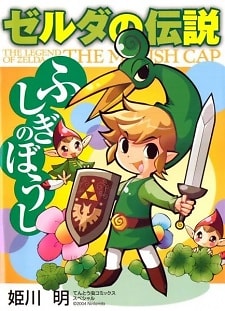
Unsurprisingly, one of the lesser worlds from The Legend of Zelda franchise results in a lesser Zelda manga. The Wind Waker's retro cartoon-esque art style may sound like an ideal fit for manga, but it ironically ensures this adaptation has nothing substantial to add to its game. The manga adaptations of Ocarina of Time and Majora's Mask were the stories' first opportunities to be told through the more mature, detailed tone of the official art.
Before then, such a thing was impossible due to the Nintendo 64's limited capabilities. Those
...
manga series enrich the original experiences, while Minish Cap's aesthetic relies heavily on animation and vibrant expressions. Such a thing is, of course, not impossible to capture in manga, but it's comprised relative to its brethren.
Furthermore, rendering 3D graphics and creating still, 2D images are concepts that can be extremely far apart. The art direction of the Wind Waker-related games aims to transmit the simplicity of a flat, illustrated style in a world with three-dimensional depth. There's a great disparity when it comes to technical concerns, such as the quality of cel-shading, but on a fundamental level, Wind Waker's character designs don't require a ton of effort to capture.
The quality of the methods conveying those designs can vary greatly, but the original character designs are barely altered when transitioning to other formats. This can be seen in the minimal visual differences between the same Wind Waker and Minish Cap characters, despite them being in entirely different graphic styles. That style isn't as limited as more traditional games like Ocarina of Time, whose more realistic art style pushes the graphical demands of the game to a goal that was never achievable.
Bringing out that realism on a 2D image is much less demanding than rendering all that detail in a 3D game, both with regards to the time needed to create it, and the hardware power required to render it. Thus, Ocarina of Time in manga format can be realistically expected to be a more accurate representation of the game's concept art.
On the other hand, a manga adapting Minish Cap is replicating something that was already achieved and uncompromised. The Minish Cap adaptation only had something to lose when it came to adapting its visuals, while Ocarina of Time and Majora's Mask could only gain. Hypothetically, I suppose that their artwork could've been terrible stick figure drawings worse than any early, textured polygonal models, but realistically speaking, that would never be allowed to pass.
Some original story events are added to the Minish Cap manga in order to bridge events or move things along faster, and it all fits in well. Some depictions of events carry more gravitas; backstories of death, tragedy, and so on. Nothing too inappropriate for a kids' fairy tale, mind. Contrivances needed to speed up the story's pacing can be forgiven by the author's presumably imposed chapter limit.
Akira Himekawa's vast stylistic range continues to amaze, and she adapts Minish Cap every bit as well as she has previous Zelda worlds. Ezlo in particular is much more appealing in the manga than he is in the game, aided by a bevy of endearingly pitiful expressions that humble the bird's haughtiness. One issue I found irritating is that it's often difficult to tell whether Link or Ezlo is talking in a panel, as several word balloons lack arrows, and Ezlo's default pose has his mouth open in nearly every panel.
As usual for Zelda manga adaptations, Minish Cap feels like a genuine work of artistic passion rather than serving as an advertisement for its source material. It only ever seems like it's advocating the game's appeal when Link is expressing awe at the world's many fantastical locations, or joyously playing with the game's numerous items. However, those are natural, in-character responses, and some acknowledgement of the game's mechanics is necessary to properly adapt its story.
While this is a well-done adaptation, it's limited by what it has to adapt. Minish Cap's tone and aesthetic ensures its world is better realized in an animated medium, whereas other games in the series had more untapped potential to draw out. The Minish Cap manga ends up feeling redundant in comparison, and the few bits where it builds on the game's narrative are spread out and slight in content. Even for hardcore Minish Cap fans, there likely isn't much to get excited about here. This manga is almost entirely the world of Minish Cap as you know it—just with less luster.
Reviewer’s Rating: 5
What did you think of this review?
Nice
 0
0
Love it
 0
0
Funny
 0
0
Confusing
 0
0
Well-written
 0
0
Creative
 0
0Show all




.png)